Contact Center AI Explained: How Smart Automation Is Transforming Customer Support in 2025
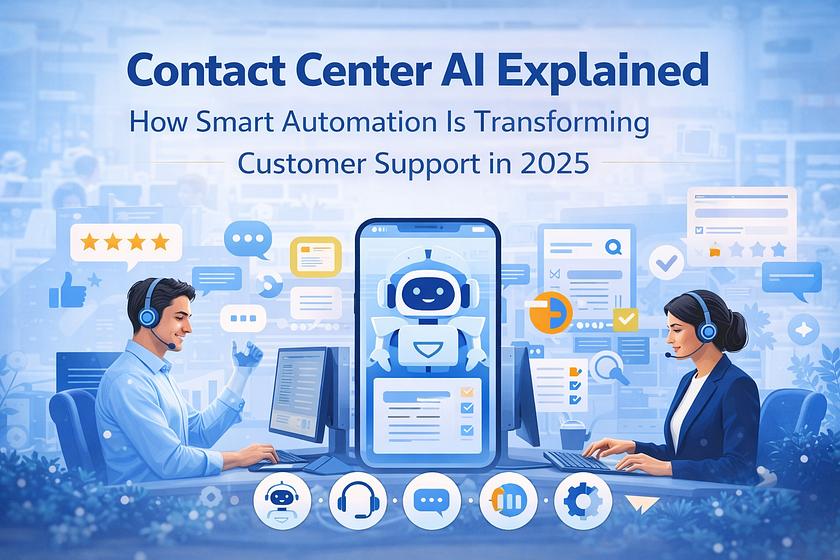
Customer expectations are higher than ever. People want quick answers, personalized service, and smooth experiences across calls, chat, email, and social media. To meet these demands, many businesses are now turning to Contact Center AI (CCAI) — a powerful combination of artificial intelligence and customer support technology.
In 2025, Contact Center AI is no longer a future concept. It has become a practical tool that helps companies improve service quality while reducing operational costs.
🤖 What Is Contact Center AI (CCAI)?
Contact Center AI refers to the use of AI-powered tools such as chatbots, voice bots, speech recognition, machine learning, and analytics to automate and enhance customer interactions in contact centers.
Instead of relying only on human agents, AI helps handle repetitive tasks, understand customer intent, and assist agents with real-time suggestions.
- Phone calls
- Live chat
- Messaging apps
- Email support
- Social media platforms
The aim is to deliver faster, smarter, and more consistent customer service.
⚙️ How Does Contact Center AI Work?
CCAI systems combine several technologies to manage conversations and support agents:
1. Natural Language Processing (NLP)
NLP helps AI understand what customers are saying or typing, even if the language is informal or mixed.
2. Intelligent Virtual Agents
AI chatbots and voice bots can answer FAQs, track orders, reset passwords, and book appointments without human help.
3. Smart Call Routing
AI identifies the issue and routes the customer to the best-suited agent, reducing transfers and wait times.
4. Agent Assist Tools
During live calls or chats, AI suggests responses, knowledge articles, and next steps to agents in real time.
5. Analytics and Insights
AI analyzes customer conversations to find trends, common problems, and service gaps.
⭐ Why Contact Center AI Matters in 2025
Businesses in 2025 face challenges like rising service costs, staff shortages, and customers who expect instant responses. CCAI helps solve these problems.
✔ Faster Response Times
AI handles routine queries instantly, cutting long waiting queues.
✔ Lower Support Costs
Automation reduces the need for large support teams while maintaining service quality.
✔ Better Customer Experience
Personalized replies and faster resolution improve satisfaction and loyalty.
✔ Higher Agent Productivity
Agents spend more time on complex problems instead of repetitive questions.
✔ Data-Driven Decisions
AI insights help businesses improve products and processes based on real customer feedback.
🏢 Industries Using Contact Center AI
Contact Center AI is widely used across industries such as:
- E-commerce and retail
- Banking and financial services
- Telecom and utilities
- Healthcare
- Travel and hospitality
- SaaS and tech support
Any business that handles high customer interaction volumes can benefit from AI-driven support.
🚀 Future of Contact Center AI
The next phase of CCAI includes Agentic AI, where AI systems can take actions independently, complete entire workflows, and resolve issues without human involvement. This will allow:
- Fully automated complaint resolution
- Proactive customer support
- Predictive service interventions
Human agents will focus more on emotional intelligence, complex decision-making, and relationship management.
🔚 Final Thoughts
Contact Center AI is reshaping customer support by making it faster, smarter, and more scalable. In 2025, companies that adopt AI-driven contact centers are not just reducing costs — they are delivering better customer experiences and staying competitive in a digital-first world.
As customer expectations continue to rise, Contact Center AI will no longer be optional. It will be a core part of how modern businesses communicate, support, and grow.


Comments
Post a Comment