Customer Experience Management (CEM) - What Is It & How It Works?
In today’s competitive digital world, customers no longer choose brands based only on price or product quality. They choose brands based on how they feel during every interaction — from browsing a website to receiving after-sales support. This is where Customer Experience Management (CEM) becomes a game changer.
Customer Experience Management helps businesses understand, manage, and improve every touchpoint in the customer journey. When done right, it builds trust, loyalty, and long-term growth.
Let’s explore what CEM really means and how it works in real life.
What Is Customer Experience Management (CEM)?
Customer Experience Management (CEM) is the process of tracking, analyzing, and improving all interactions a customer has with a brand. These interactions can happen online, in-store, on social media, through customer support, mobile apps, or emails.
The goal of CEM is simple:
👉 Deliver consistent, positive, and memorable experiences at every stage of the customer journey.
Instead of reacting only when problems occur, CEM helps businesses proactively improve satisfaction, reduce friction, and exceed expectations.
Why Is Customer Experience So Important Today?
Modern customers have endless choices. If they face slow service, poor communication, or confusing processes, they can easily switch to another brand.
Here’s why CEM matters:
- Increases customer loyalty and retention
- Improves brand reputation and trust
- Boosts repeat purchases and referrals
- Reduces complaints and churn
- Helps businesses stand out from competitors
Happy customers don’t just buy — they promote your brand.
How Does Customer Experience Management Work?
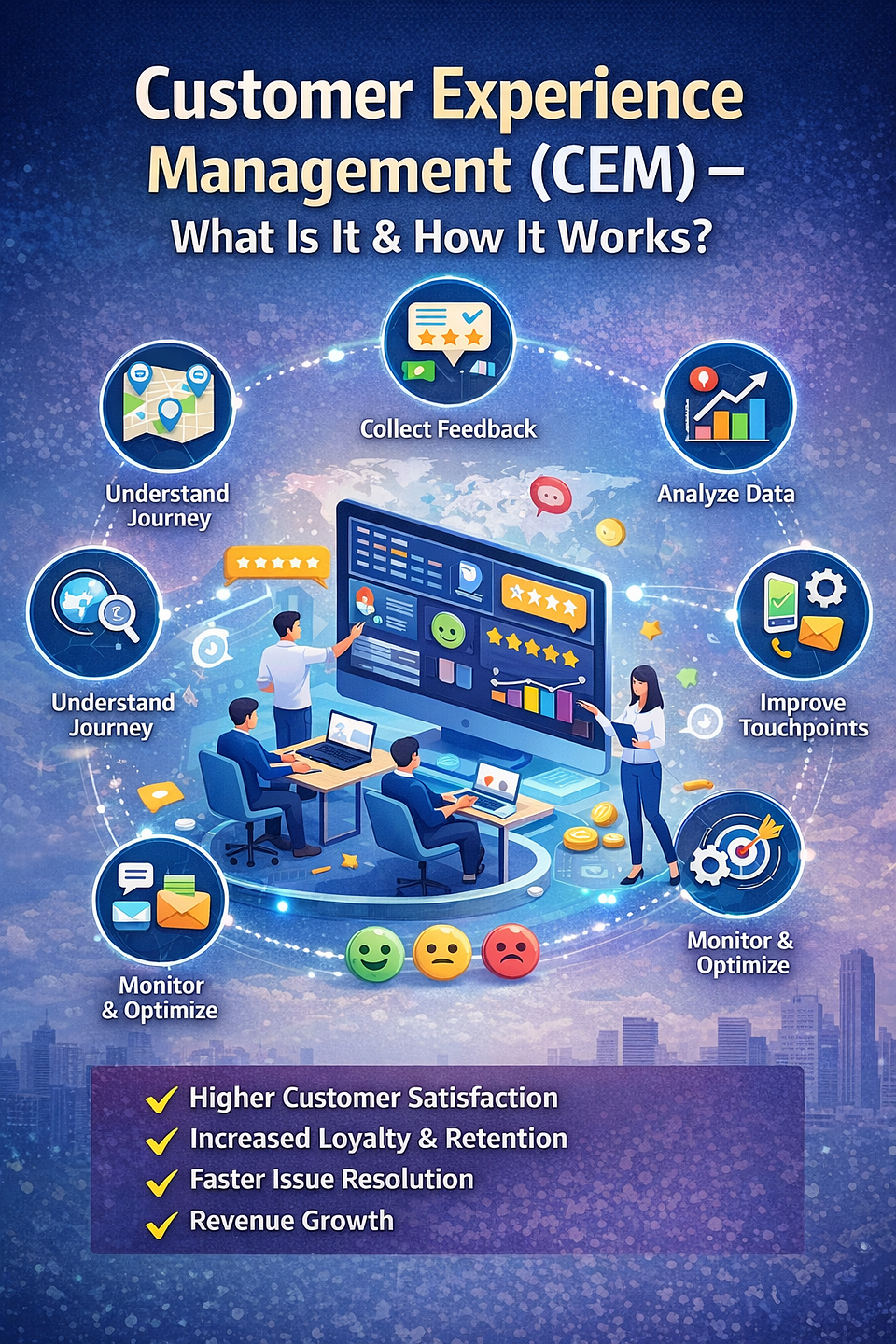
CEM works through a structured approach that connects people, processes, and technology.
1. Understanding the Customer Journey
Businesses first map the entire customer journey — from awareness and purchase to support and renewal. This helps identify pain points, delays, and opportunities for improvement.
2. Collecting Customer Feedback
Feedback is collected through surveys, reviews, chat conversations, call recordings, social media comments, and website behavior. This data reveals what customers truly feel.
3. Analyzing Customer Data
Advanced tools analyze feedback and behavioral data to uncover patterns, trends, and root causes of dissatisfaction or delight.
4. Improving Touchpoints
Based on insights, businesses optimize processes, train teams, update systems, and personalize communication to enhance each interaction.
5. Monitoring and Continuous Optimization
Customer expectations change constantly. CEM is an ongoing process where performance is tracked using KPIs such as customer satisfaction, response time, and resolution rate.
Key Components of a Strong CEM Strategy
Customer Journey Mapping
Visualizing every interaction helps remove friction and improve flow.
Omnichannel Engagement
Customers expect seamless experiences across phone, email, chat, social media, and in-store channels.
Personalization
Using data to tailor messages, offers, and support creates meaningful connections.
Employee Enablement
Well-trained teams empowered with the right tools deliver better experiences.
Technology & Automation
AI, CRM platforms, analytics tools, and automation improve speed, accuracy, and consistency.
Benefits of Implementing Customer Experience Management
- Higher customer satisfaction
- Improved customer lifetime value
- Faster issue resolution
- Better business insights
- Stronger competitive advantage
- Increased revenue growth
Organizations that prioritize experience often outperform competitors in both loyalty and profitability.
Real-World Example of CEM in Action
Imagine an online retail company that tracks customer behavior on its website. If a customer abandons their cart, the system sends a personalized reminder email with a small discount. If the customer contacts support, agents already have full purchase history and preferences. This seamless experience makes the customer feel valued and increases the chances of conversion.
That’s Customer Experience Management working behind the scenes.
Future of Customer Experience Management
The future of CEM lies in AI-powered personalization, predictive analytics, voice automation, and real-time feedback systems. Businesses that invest in intelligent customer experience platforms will be able to anticipate needs rather than just respond to them.
Final Thoughts
Customer Experience Management is no longer optional — it is a business necessity. Companies that actively manage and improve customer interactions build stronger relationships, create loyal customers, and achieve sustainable growth.
If your goal is to stand out in a crowded market, investing in CEM is one of the smartest moves you can make.


Comments
Post a Comment