Tesla Drops Out of India’s Top 10 EV Sales Rankings as Maruti Quietly Breaks In
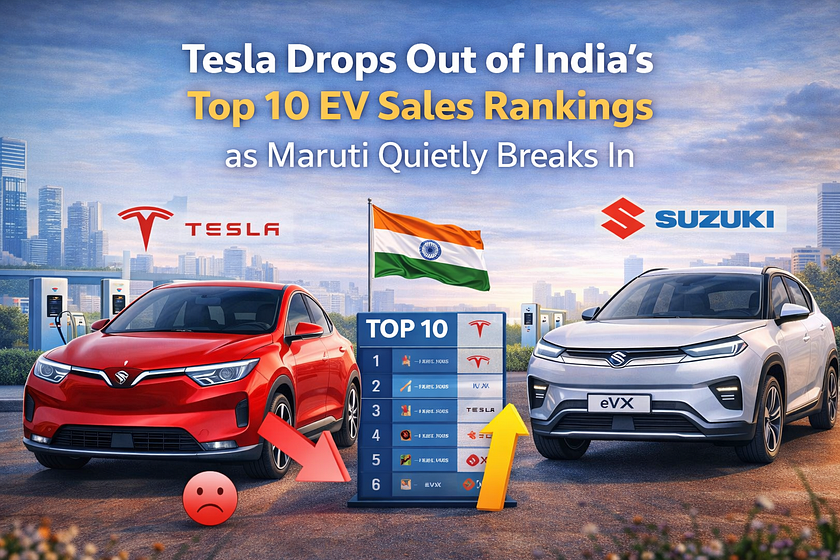
India’s electric vehicle (EV) market has been evolving rapidly, with new models, shifting consumer preferences, and changing brand dynamics shaping the competitive landscape. Recent sales data suggests a notable change — Tesla has slipped out of the top 10 EV brands in India, while Maruti Suzuki, despite its late entry into EVs, has quietly entered the ranking. This shift highlights how fast the Indian EV market is moving and how local strategies are increasingly paying off.
📊 The Latest EV Sales Scene in India
India’s EV sales have grown significantly over 2025 and into early 2026, with cumulative sales figures showing rising demand for electric cars. In the first 10 months of 2025 alone, over 1.44 lakh EVs were sold, surpassing previous full-year totals and projecting strong growth for the full year. Tata Motors continued to dominate with around 40% market share, followed by MG and Mahindra as key challengers.
According to historical sales data from late 2025, Tesla’s Indian sales had fallen to relatively low numbers (around 40 units in one recent month) compared with a diverse range of other brands. As a result, Tesla — once a global EV leader — did not make the top 10 sales ranking list, while brands like Maruti Suzuki (with early EV entries) appeared in the extended rankings.
This is noteworthy because Tesla is often seen as one of the most influential electric car companies worldwide. However, in the Indian context, local adoption and strategic product placement have so far shaped a very different competitive order.
🚗 Why Tesla’s Position Weakened in India
Several factors may explain why Tesla’s sales remained low in India through 2025:
- Late Market Entry: Tesla has not rolled out locally manufactured EVs nor tablets of broader model options in India, meaning its limited imports face higher duties and less competitive pricing.
- Strong Domestic Competition: Indian brands like Tata Motors and MG have aggressively expanded their EV offerings with models that meet local needs and price expectations.
- Emergence of Local and New Brands: New players such as VinFast have aggressively entered the market with scaled operations and a dedicated dealer network, further increasing competition.
These combined trends have contributed to Tesla’s relatively modest sales figures in India and its slip out of India’s EV top 10.
🚘 Maruti Suzuki’s EV Entry Makes an Impact
While Tesla’s ranking faded, Maruti Suzuki quietly made it onto India’s EV roadmap and early sales lists. Though still limited in overall volume, the brand’s presence is meaningful.
Maruti’s upcoming models, such as the e-Vitara, are expected to launch with competitive specs and pricing suited to Indian buyers. The e-Vitara, revealed in late 2025, offers up to around 543 km claimed range with multiple battery options — making it a strong candidate in the mainstream EV segment once it hits the market.
🏆 The Current EV Leaders in India
As of the latest sales data from late 2025, the top EV makers in India remain:
- Tata Motors — Huge lead with a strong market share.
- JSW MG Motor India — Rapid growth with models like the Windsor EV.
- Mahindra & Mahindra — Significant growth year-on-year.
- Hyundai / BYD / VinFast — Emerging contenders.
Other brands such as Mercedes-Benz, BMW, and even Maruti Suzuki have started appearing in the broader extended rankings, reflecting diversification in the market. Meanwhile, Tesla’s sales were significantly lower in comparison, leading to its absence from many top-10 lists in India.
📈 What This Means for the Indian EV Market
India’s EV landscape in 2025–2026 is clearly in a phase of expansion and realignment:
- Localisation wins: Domestic and locally tailored EV products are performing best.
- New entrants matter: Brands like VinFast are rapidly gaining ground, showing India’s EV market is open to new competition.
- Affordable cars drive adoption: Cars with practical pricing and range are seeing stronger uptake than luxury imports alone.
🔚 Final Thoughts
Tesla’s drop from the top 10 EV sales ranks in India doesn’t diminish its global influence, but it does highlight how unique and competitive the Indian EV market has become. With local manufacturers leading the charge, new models on the horizon, and brands like Maruti Suzuki positioning for long-term growth, the Indian EV race is far from predictable.
For buyers, this means more choices, better pricing power, and a rapidly evolving market — where innovation and understanding local preferences are key to success.


Comments
Post a Comment