Conversational AI Assistants vs Chatbots: What’s the Real Difference and Why It Matters
Introduction
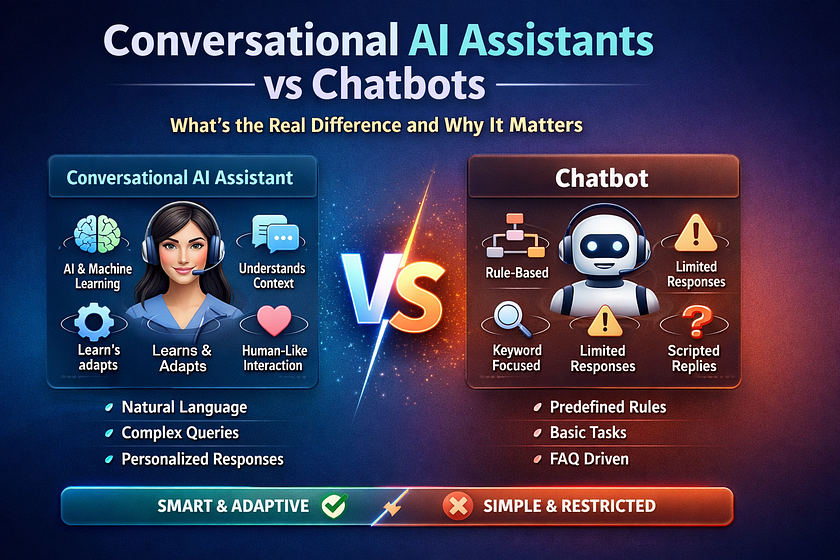
If you’ve ever chatted with a brand online, chances are you’ve interacted with a chatbot — or maybe something far more advanced. While chatbots and conversational AI assistants are often used interchangeably, they are not the same thing. One follows scripts. The other understands, learns, and responds like a real conversation.
As businesses move toward smarter, faster, and more personalized customer interactions, understanding this difference is no longer optional — it’s essential.
Let’s break it down in a simple, no-jargon way.
What Is a Chatbot?
A chatbot is a rule-based or keyword-driven system designed to answer specific, predefined questions.
How chatbots work:
- Follow fixed decision trees
- Respond to exact commands or keywords
- Limited understanding of context
- Struggle with complex or unexpected queries
Example:
You type “Track my order” → The chatbot gives you a tracking link.
You type anything slightly different → It may get confused.
Chatbots are great for basic tasks, FAQs, and simple workflows — but that’s where their limits show.
What Is a Conversational AI Assistant?
A conversational AI assistant goes several steps further. It uses natural language processing (NLP), machine learning, and AI models to understand intent, context, and even emotion.
How conversational AI assistants work:
- Understand natural human language
- Learn from past interactions
- Maintain conversation context
- Handle complex, multi-step queries
- Deliver personalized responses
Example:
You say, “My order hasn’t arrived yet, and I’m really frustrated.”
The AI understands the issue, emotion, checks order status, and responds empathetically — without needing exact keywords.
Key Differences at a Glance
FeatureChatbotConversational AI AssistantIntelligenceRule-basedAI & ML-drivenContext awareness❌ Limited✅ StrongPersonalization❌ Minimal✅ HighLearning ability❌ No✅ YesComplex queries❌ Struggles✅ Handles easilyHuman-like interaction❌ Low✅ Very high
Use Cases: When to Use What
Chatbots are ideal for:
- FAQs
- Appointment booking
- Simple lead capture
- Order tracking
Conversational AI assistants are ideal for:
- Customer support at scale
- Sales conversations
- Technical troubleshooting
- Personalized recommendations
- Omnichannel customer experiences
Why Businesses Are Shifting to Conversational AI
Modern customers expect instant, accurate, and human-like responses. They don’t want to repeat themselves or navigate endless menus.
Conversational AI helps businesses:
- Reduce support costs
- Improve customer satisfaction
- Increase conversions
- Offer 24/7 intelligent support
- Scale conversations without losing quality
This is why industries like e-commerce, banking, healthcare, real estate, and SaaS are rapidly adopting conversational AI assistants.
The Bottom Line
Chatbots are helpful — but limited. Conversational AI assistants are smarter, more adaptive, and future-ready.
If your goal is to simply answer basic questions, a chatbot might be enough. But if you want to build real conversations, improve customer experience, and stay competitive, conversational AI is the clear winner.


Comments
Post a Comment