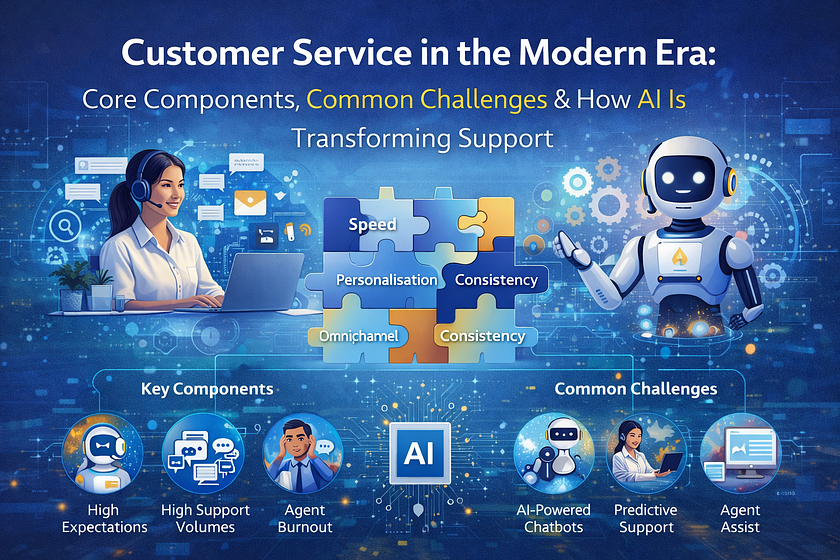
Customer Service in the Modern Era: Core Components, Common Challenges & How AI Is Transforming Support
Introduction
Customer service is no longer just about answering queries or resolving complaints. In today’s digital-first world, it plays a critical role in shaping how customers perceive a brand. With increasing competition and rising customer expectations, businesses must deliver fast, personalised, and consistent support across every touchpoint.
At the same time, challenges such as high query volumes, limited resources, and the demand for 24/7 availability are pushing organisations to rethink their service strategies. This is where technology — especially artificial intelligence (AI) — is redefining how customer service operates.
Key Elements of Effective Customer Service
1. Speed and Responsiveness
Modern customers expect instant responses. Whether through live chat, email, or social media, quick resolution times directly impact customer satisfaction and loyalty.
2. Personalisation
Customers want to feel understood, not treated like ticket numbers. Using past interactions, preferences, and purchase history helps businesses offer more relevant and empathetic support.
3. Omnichannel Support
Customers interact across multiple platforms — phone, chat, email, WhatsApp, social media, and websites. A seamless omnichannel experience ensures conversations remain consistent regardless of the channel used.
4. Skilled and Empathetic Agents
While technology supports service delivery, human empathy remains essential. Well-trained agents who can listen, understand emotions, and resolve issues effectively make a significant difference.
5. Consistency and Reliability
Delivering the same quality of service every time builds trust. Clear processes, knowledge bases, and service standards help maintain reliability across teams.
Common Challenges in Customer Service Today
Rising Customer Expectations
Customers now expect faster, smarter, and more personalised service than ever before. Failing to meet these expectations often leads to frustration and churn.
High Support Volumes
As businesses scale, so do customer queries. Managing large volumes without increasing costs or compromising quality is a major challenge.
Agent Burnout and Turnover
Repetitive queries, pressure to meet performance targets, and emotional conversations can lead to burnout among support teams.
Data Silos
Disconnected systems prevent agents from accessing complete customer information, resulting in repeated questions and inconsistent service experiences.
The Role of AI in Transforming Customer Service
AI has emerged as a powerful solution to many of these challenges, helping businesses deliver faster, smarter, and more efficient support.
AI-Powered Chatbots and Virtual Assistants
Chatbots handle routine queries such as order tracking, FAQs, and account information, freeing human agents to focus on complex issues. They also provide 24/7 support, improving availability.
Intelligent Routing and Automation
AI automatically routes queries to the right agents based on intent, urgency, or skill set. It can also automate repetitive tasks like ticket categorisation and follow-ups.
Predictive and Proactive Support
AI analyses customer behaviour and interaction data to predict potential issues and address them before customers even raise a complaint.
Sentiment Analysis and Quality Monitoring
By analysing tone and language, AI helps detect customer sentiment in real time. This enables supervisors to intervene when conversations escalate and improve overall service quality.
Agent Assist Tools
AI supports agents during live interactions by suggesting responses, summarising conversations, and retrieving relevant information instantly — improving efficiency and accuracy.
Why AI-Driven Customer Service Is the Future
AI does not replace human agents; it enhances their capabilities. By reducing workload, improving response times, and enabling data-driven insights, AI allows support teams to focus on what truly matters — building strong customer relationships.
Businesses that successfully combine human empathy with intelligent automation are better positioned to deliver exceptional customer experiences, retain customers, and scale efficiently.
Conclusion
Customer service has evolved from a reactive support function into a strategic driver of brand loyalty and business growth. While challenges such as rising expectations and high support volumes persist, AI offers powerful tools to overcome them.
By embracing AI-driven customer service solutions, organisations can deliver faster, more personalised, and more consistent experiences — setting themselves apart in an increasingly competitive marketplace.


Comments
Post a Comment