The Future of Enterprise Growth: 5 High-Impact Conversational AI Use Cases for 2026
Introduction
Conversational AI is no longer just a support tool — it’s becoming a strategic growth engine for modern businesses. As we move into 2026, companies are shifting from basic automation to intelligent, context-aware AI systems that drive revenue, reduce operational costs, and enhance customer experiences at scale.
From customer service to sales acceleration, conversational AI is transforming how brands interact with customers across digital channels. Let’s explore the five most strategic use cases that will define business success in 2026.
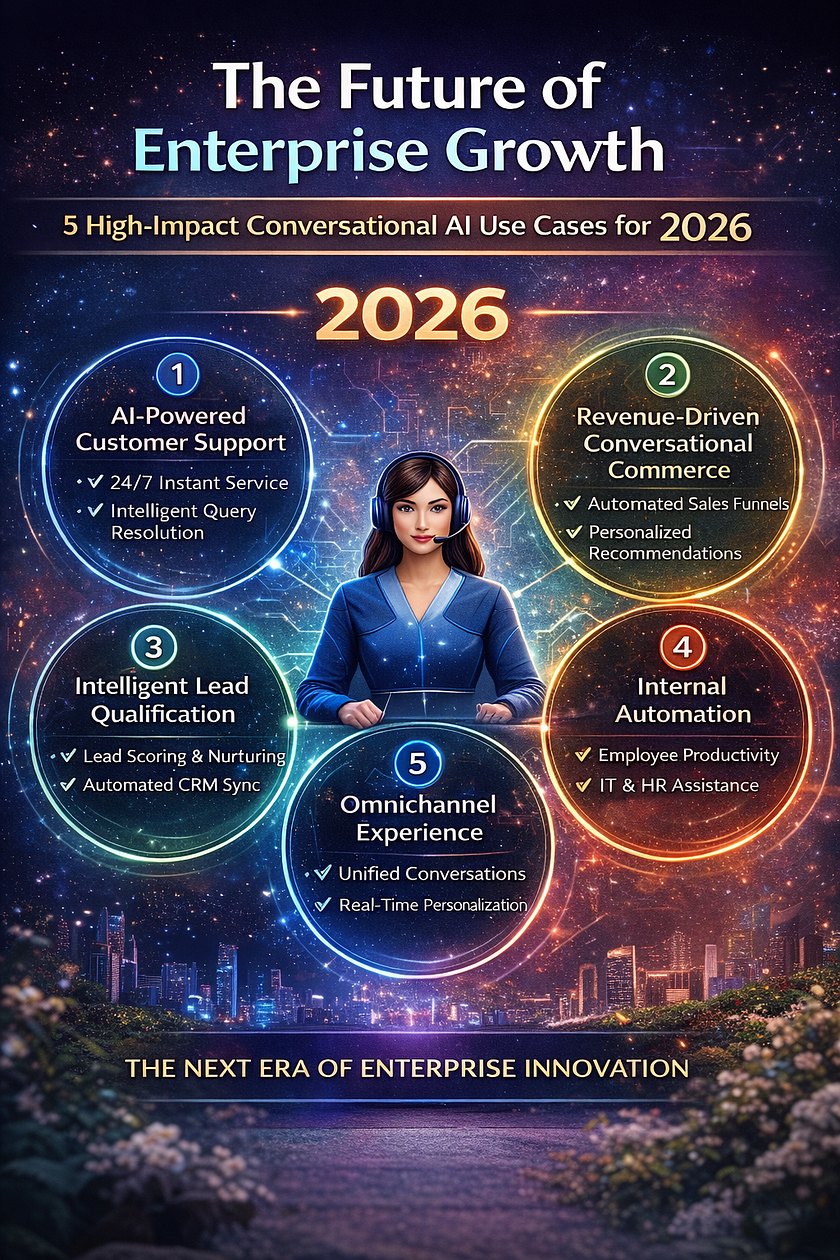
1. AI-Powered Customer Support That Scales Instantly
Customer expectations are higher than ever. They demand fast, accurate, and personalized responses — 24/7.
In 2026, conversational AI will:
- Resolve complex queries without human intervention
- Understand intent, context, and sentiment
- Escalate intelligently when human support is required
- Reduce average response and resolution times
Instead of replacing support teams, AI will work alongside them — handling repetitive requests while human agents focus on high-value interactions. The result? Lower costs and higher customer satisfaction.
2. Revenue-Driven Conversational Commerce
Conversational AI is rapidly becoming a powerful sales channel.
Businesses are using AI assistants to:
- Guide customers through product selection
- Offer personalized recommendations
- Answer pre-purchase questions instantly
- Reduce cart abandonment
- Upsell and cross-sell intelligently
By 2026, AI-driven conversations will feel more like speaking to a knowledgeable sales consultant rather than interacting with a scripted bot. This shift will significantly increase conversion rates and customer lifetime value.
3. Intelligent Lead Qualification & Nurturing
Sales teams often waste time chasing unqualified leads. Conversational AI changes that.
Strategic benefits include:
- Real-time lead scoring based on behavior and responses
- Automated appointment booking
- Personalized follow-ups
- Data syncing with CRM systems
AI assistants can engage website visitors instantly, ask qualifying questions, and route high-intent prospects directly to sales teams. This shortens sales cycles and improves close rates.
4. Internal Automation & Employee Productivity
Conversational AI isn’t just customer-facing — it’s transforming internal operations too.
By 2026, businesses will deploy AI assistants internally to:
- Automate HR queries
- Assist with onboarding
- Provide IT support
- Retrieve internal documentation
- Summarize meetings and reports
Instead of searching through emails or documents, employees can simply ask an AI assistant. This reduces friction and improves productivity across departments.
5. Omnichannel Experience Orchestration
Customers interact across websites, apps, WhatsApp, social media, and voice platforms. Managing these touchpoints manually is nearly impossible.
Conversational AI enables:
- Unified conversation history across channels
- Context continuity (no repeating information)
- Consistent brand messaging
- Real-time personalization
In 2026, businesses that offer seamless omnichannel conversations will outperform competitors still operating in silos.
Why 2026 Is a Turning Point
The next wave of conversational AI will be defined by:
- Generative AI integration
- Emotional intelligence and sentiment analysis
- Hyper-personalization at scale
- Deeper integration with business systems
- Data-driven decision-making insights
Businesses that adopt conversational AI strategically — not just operationally — will gain a major competitive advantage.
Final Thoughts
Conversational AI in 2026 won’t just answer questions — it will drive growth, enhance loyalty, and optimize operations.
The key is to move beyond basic chatbots and implement intelligent, scalable AI solutions aligned with clear business goals.
Companies that treat conversational AI as a long-term strategy rather than a short-term tool will lead the next era of digital transformation.


Comments
Post a Comment