Customer Service Automation in 2026: The Ultimate Guide to Smarter Support
Customer expectations are evolving faster than ever. In 2026, people want instant responses, personalized interactions, and seamless support across channels. Businesses that rely only on manual customer service processes are struggling to keep up.
That’s where customer service automation comes in — not to replace human agents, but to empower them and improve overall efficiency.
This complete guide explains what customer service automation is, how it works, its benefits, tools, challenges, and how businesses can implement it successfully in 2026.
What Is Customer Service Automation?
Customer service automation refers to the use of technology — such as AI, chatbots, workflows, and analytics — to handle repetitive support tasks with minimal human intervention.
Instead of manually responding to every inquiry, businesses use automated systems to:
- Answer common questions
- Route tickets to the right department
- Provide instant order updates
- Send proactive notifications
- Collect customer feedback
The goal is simple: deliver faster, more efficient, and consistent customer support.
Why Customer Service Automation Matters in 2026
In today’s digital-first world:
✔ Customers expect 24/7 support
✔ Response time directly impacts satisfaction
✔ High ticket volumes overwhelm support teams
✔ Personalization is no longer optional
Automation allows businesses to scale support operations without increasing operational costs significantly.
Companies that adopt smart automation tools report:
- Reduced response times
- Higher customer satisfaction scores
- Lower support costs
- Improved agent productivity
How Customer Service Automation Works
Customer service automation typically involves a combination of AI tools, CRM systems, and workflow management software.
Here’s how the process works:
1. Query Capture
Customer inquiries come through multiple channels — website chat, email, social media, or phone.
2. AI-Based Understanding
Natural Language Processing (NLP) analyzes the customer’s message to understand intent and urgency.
3. Automated Response or Routing
- If it’s a simple query (like order tracking), the system responds instantly.
- If it’s complex, the system assigns it to the right human agent.
4. Continuous Learning
Machine learning models improve over time by analyzing past interactions and feedback.
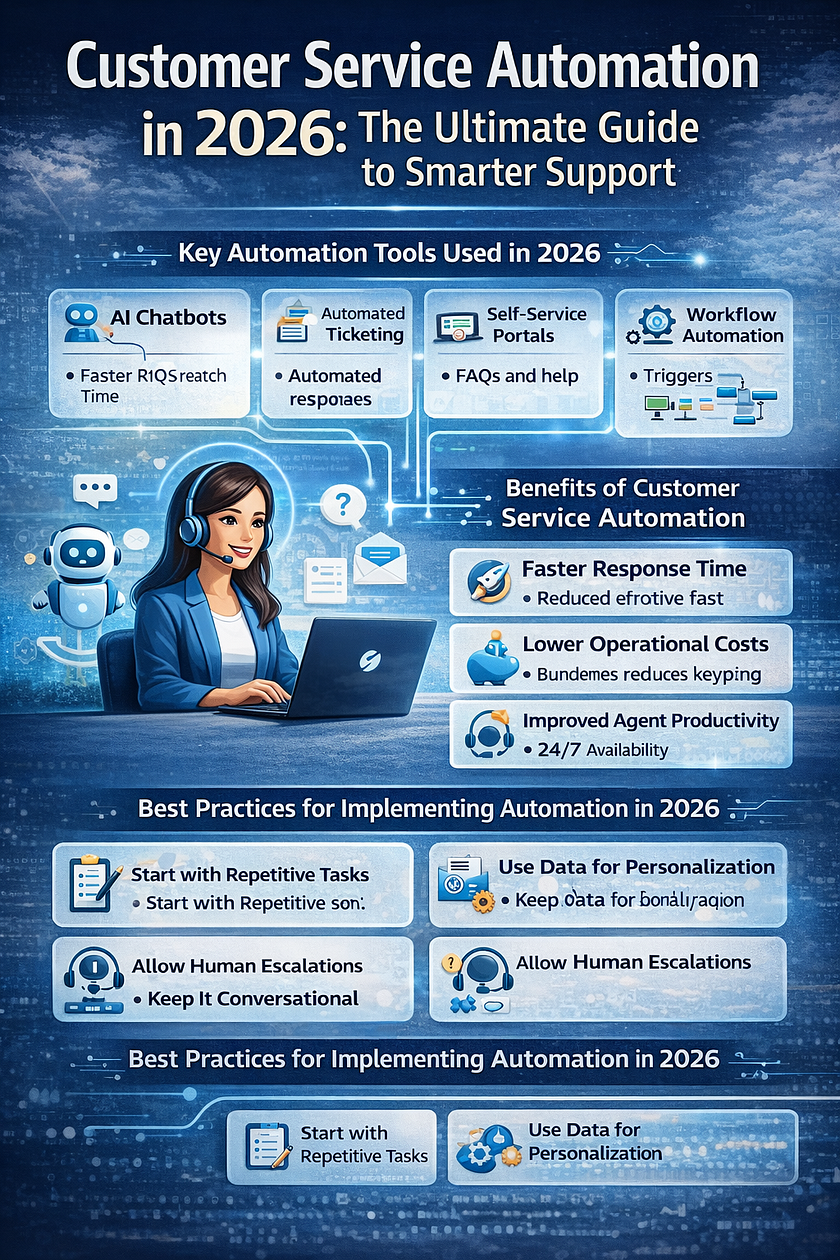
Key Automation Tools Used in 2026
1. AI Chatbots
Handle FAQs, booking confirmations, refunds, and basic troubleshooting.
2. Automated Ticketing Systems
Automatically categorize and assign support tickets.
3. Self-Service Portals
Knowledge bases and help centers allow customers to solve issues independently.
4. Workflow Automation
Triggers automatic emails, follow-ups, and reminders.
5. Voice Bots & IVR Systems
Automated phone support that routes calls intelligently.
6. Predictive Analytics
Identifies potential issues before customers even complain.
Benefits of Customer Service Automation
🚀 Faster Response Time
Automation reduces wait times from hours to seconds.
💰 Lower Operational Costs
Businesses can manage higher ticket volumes without hiring large teams.
🎯 Consistent Customer Experience
Automated systems deliver standardized responses, reducing errors.
📈 Improved Agent Productivity
Human agents focus on complex, high-value interactions.
🌍 24/7 Availability
Support doesn’t stop after office hours.
Industries Benefiting the Most
- E-commerce (order tracking & returns)
- Banking & FinTech (account queries, fraud alerts)
- Healthcare (appointment scheduling)
- Telecom (billing & service activation)
- SaaS companies (technical troubleshooting)
Challenges of Customer Service Automation
While automation offers major advantages, it also comes with challenges:
❌ Over-automation can frustrate customers
❌ Poorly trained AI may misunderstand queries
❌ Lack of personalization reduces customer trust
❌ Initial setup costs can be high
The key is balance — combining automation with human empathy.
Best Practices for Implementing Automation in 2026
1. Start with Repetitive Tasks
Automate FAQs and simple queries first.
2. Maintain Human Escalation Options
Always allow customers to speak with a human when needed.
3. Use Data for Personalization
Leverage CRM data to provide contextual responses.
4. Monitor and Optimize
Track KPIs like response time, CSAT, and resolution rate.
5. Keep It Conversational
Modern AI systems should feel natural and helpful — not robotic.
The Future of Customer Service Automation
By 2026 and beyond, automation will move toward:
- Hyper-personalized AI conversations
- Emotion-detection technology
- Voice-first support systems
- Proactive customer engagement
- AI-powered virtual assistants working alongside agents
The future isn’t about replacing humans — it’s about building hybrid support systems where AI handles speed and scale, while humans deliver empathy and problem-solving.
Final Thoughts
Customer service automation in 2026 is no longer optional — it’s a competitive advantage. Businesses that combine intelligent automation with human expertise can deliver faster, smarter, and more satisfying support experiences.
The real win? Happier customers, empowered agents, and scalable growth.
Automation isn’t about removing the human touch. It’s about making it stronger where it matters most.


Comments
Post a Comment