Global Customer Support Services: Everything Businesses Need to Know
Introduction
Customer expectations have changed dramatically over the past decade. Today, customers expect fast, personalized, and consistent support regardless of where they are in the world or which channel they use to contact a business. Whether it’s through phone, email, live chat, social media, or messaging apps, delivering exceptional customer service has become a key factor in building loyalty and driving business growth.
This is where global customer support services come into play. By offering around-the-clock, multilingual, and omnichannel support, businesses can meet the needs of international customers while improving customer satisfaction and operational efficiency.
In this guide, we’ll explore what global customer support services are, why they matter, their key benefits, common challenges, and best practices for implementing a successful global support strategy.
What Are Global Customer Support Services?
Global customer support services refer to the process of providing customer assistance across multiple countries, languages, and time zones. These services ensure customers receive timely help regardless of their location.
Support can be delivered through various channels, including:
- Phone support
- Email support
- Live chat
- Social media
- WhatsApp and messaging apps
- Self-service portals
- AI-powered chatbots
- Video support
The goal is to create a seamless customer experience while maintaining consistent service quality worldwide.
Why Global Customer Support Is Important
As businesses expand into international markets, customer expectations continue to rise. Delayed responses or language barriers can quickly lead to customer dissatisfaction and lost revenue.
Global customer support helps businesses:
- Deliver 24/7 customer assistance
- Improve customer satisfaction
- Expand into new international markets
- Build stronger customer relationships
- Increase customer retention
- Protect brand reputation
- Stay competitive in global markets
Customers are more likely to remain loyal to brands that provide quick, reliable, and personalized support.
Key Features of Global Customer Support Services
An effective global customer support strategy includes several essential features.
1. Multilingual Support
Serving customers in their preferred language improves communication and reduces misunderstandings.
Benefits include:
- Better customer experiences
- Higher customer satisfaction
- Increased trust
- Improved first-contact resolution
2. 24/7 Customer Assistance
Customers expect support whenever they need it, regardless of time zones.
Round-the-clock support helps businesses:
- Reduce response times
- Handle urgent issues quickly
- Improve customer loyalty
- Support international operations
3. Omnichannel Communication
Customers switch between communication channels during their journey.
An omnichannel approach integrates:
- Voice calls
- Live chat
- Social media
- Mobile messaging
- Customer portals
This creates a consistent experience across every touchpoint.
4. AI-Powered Customer Support
Artificial intelligence has become an essential part of modern customer service.
AI helps businesses:
- Answer routine questions
- Route tickets automatically
- Provide instant responses
- Support agents with recommendations
- Reduce wait times
Human agents can then focus on more complex customer issues.
5. Knowledge Management
A centralized knowledge base allows both customers and support agents to find accurate information quickly.
Resources may include:
- FAQs
- Troubleshooting guides
- Product documentation
- Video tutorials
- User manuals
Self-service options often reduce support costs while improving customer satisfaction.
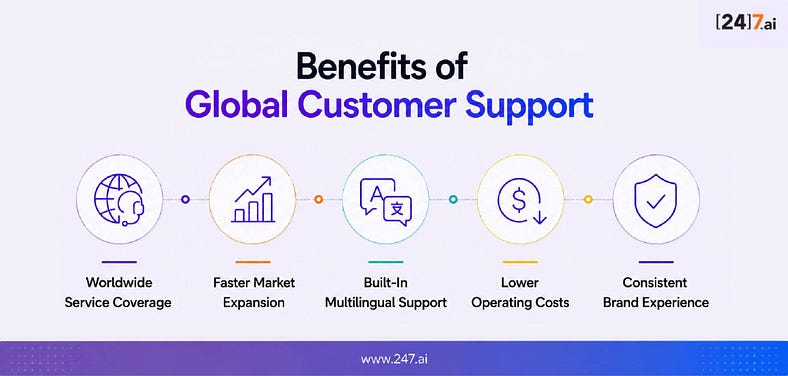
Benefits of Global Customer Support Services
Improved Customer Satisfaction
Fast and reliable support creates positive customer experiences and encourages repeat business.
Increased Customer Retention
Customers are more likely to stay with brands that resolve issues quickly and professionally.
Stronger Brand Reputation
Consistent customer service across multiple regions strengthens brand credibility.
Faster Issue Resolution
Well-trained support teams and advanced technology reduce average handling time and improve first-contact resolution.
Cost Efficiency
Many organizations combine automation, outsourcing, and centralized operations to reduce operational costs without sacrificing service quality.
Business Scalability
Global customer support makes it easier to enter new markets while maintaining consistent service standards.
Common Challenges
Despite its advantages, managing global customer support comes with challenges.
Language Differences
Communicating effectively with customers across multiple languages requires skilled multilingual agents and accurate translation tools.
Time Zone Management
Businesses must coordinate teams across different regions to provide uninterrupted service.
Cultural Expectations
Customer communication styles vary across countries. Support teams should understand cultural preferences and local business etiquette.
Maintaining Consistent Service Quality
Organizations must ensure customers receive the same level of support regardless of location or communication channel.
Data Security and Compliance
Global support teams often handle sensitive customer information.
Businesses must comply with regulations such as:
- GDPR
- PCI DSS
- ISO 27001
- Regional privacy laws
Protecting customer data is essential for maintaining trust.
Best Practices for Global Customer Support
Successful organizations follow several proven strategies.
Invest in Agent Training
Provide regular training on:
- Product knowledge
- Communication skills
- Cultural awareness
- Customer empathy
- Problem-solving
Use AI Wisely
Automation should enhance — not replace — human interactions.
Use AI for repetitive tasks while allowing agents to manage complex conversations.
Standardize Processes
Create consistent workflows for:
- Ticket handling
- Escalation procedures
- Quality monitoring
- Customer follow-ups
Monitor Performance Metrics
Track important customer support KPIs such as:
- First Response Time (FRT)
- Average Resolution Time
- Customer Satisfaction (CSAT)
- Net Promoter Score (NPS)
- First Contact Resolution (FCR)
- Customer Effort Score (CES)
These metrics help identify improvement opportunities.
Gather Customer Feedback
Regular surveys and reviews help businesses understand customer expectations and improve support quality.
Industries That Benefit from Global Customer Support
Many industries rely on international customer support, including:
- E-commerce
- SaaS
- Banking and Financial Services
- Healthcare
- Telecommunications
- Travel and Hospitality
- Retail
- Technology
- Logistics
- Manufacturing
How to Choose a Global Customer Support Provider
When selecting a service provider, consider:
- Multilingual capabilities
- Industry expertise
- 24/7 availability
- AI and automation tools
- Omnichannel support
- Data security certifications
- Scalability
- Reporting and analytics
- Customer success track record
Choosing the right partner can significantly improve customer experience and operational efficiency.
Future Trends in Global Customer Support
The future of customer support is becoming increasingly technology-driven.
Key trends include:
- AI-powered virtual assistants
- Generative AI for customer interactions
- Predictive customer service
- Hyper-personalized support
- Voice AI
- Proactive customer engagement
- Advanced analytics
- Automation with human oversight
Businesses that adopt these innovations will be better equipped to meet evolving customer expectations.
Conclusion
Global customer support services are no longer optional for businesses serving international markets. Customers expect fast, reliable, and personalized assistance across multiple channels and time zones. By combining skilled support teams, multilingual capabilities, AI-driven tools, and well-defined processes, businesses can deliver exceptional customer experiences while improving efficiency and reducing costs.
Investing in a robust global customer support strategy not only strengthens customer relationships but also positions your business for long-term growth in an increasingly connected world.
Frequently Asked Questions (FAQs)
1. What are global customer support services?
Global customer support services provide assistance to customers across different countries, languages, and time zones through channels like phone, email, chat, and social media.
2. Why is global customer support important?
It helps businesses improve customer satisfaction, build loyalty, expand into international markets, and maintain consistent service quality worldwide.
3. What technologies are used in global customer support?
Common technologies include AI chatbots, CRM systems, ticketing platforms, knowledge bases, analytics tools, and omnichannel communication solutions.
4. What are the biggest challenges in global customer support?
Language barriers, cultural differences, time zone management, maintaining service consistency, and data security are among the most common challenges.
5. How can businesses improve their global customer support?
Businesses can improve support by offering multilingual assistance, leveraging AI, training agents, using omnichannel communication, monitoring KPIs, and continuously gathering customer feedback.


Comments
Post a Comment