Payment Lifecycle Security: How to Protect Every Stage from Capture to Completion
Introduction
Every digital payment goes through several stages before it is successfully completed. From the moment a customer enters their payment details to the final settlement, each step presents unique security challenges. Cybercriminals constantly target payment systems to steal sensitive data, commit fraud, or disrupt transactions.
A single weak point in the payment lifecycle can expose organizations to financial losses, compliance violations, and damaged customer trust. That’s why businesses must implement the right security controls at every stage of the payment process.
In this guide, we’ll explain the payment lifecycle and the essential security measures needed to protect every transaction.
What Is the Payment Lifecycle?
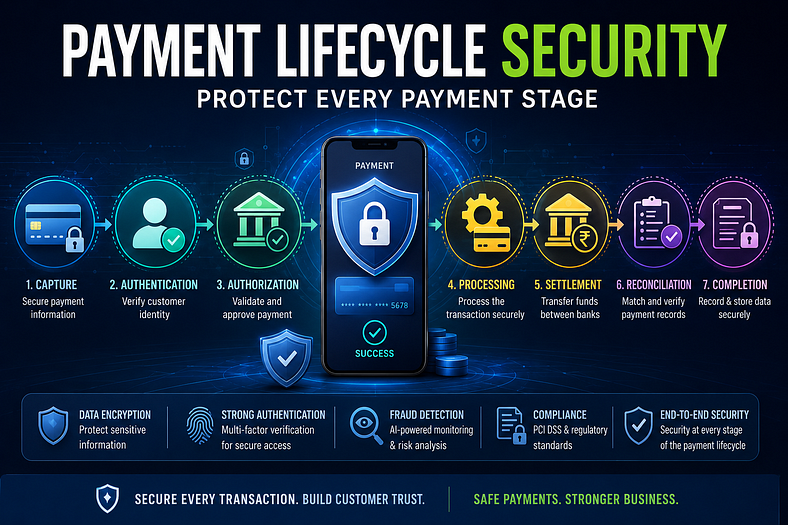
The payment lifecycle is the complete journey of a payment transaction. It begins when a customer initiates a payment and ends when the funds are successfully transferred and recorded.
The typical payment lifecycle includes:
- Payment Capture
- Authorization
- Authentication
- Processing
- Settlement
- Reconciliation
- Completion and Record Keeping
Each stage requires different security controls to minimize fraud and protect sensitive payment information.
Stage 1: Payment Capture
Payment capture is when customers provide their payment information through a website, mobile app, POS terminal, or digital wallet.
Security Risks
- Card data theft
- Fake payment forms
- Phishing attacks
- Malware
- Data interception
Security Controls
- HTTPS encryption (TLS)
- PCI DSS-compliant payment forms
- Secure payment gateways
- Input validation
- Tokenization
- Web Application Firewall (WAF)
These controls ensure payment information is protected before it enters the payment system.
Stage 2: Customer Authentication
Before processing a payment, businesses must verify the identity of the customer.
Security Risks
- Account takeover
- Credential stuffing
- Password theft
- Identity fraud
Security Controls
- Multi-Factor Authentication (MFA)
- Biometric authentication
- One-Time Passwords (OTP)
- Risk-based authentication
- Behavioral analytics
Strong authentication significantly reduces unauthorized access.
Stage 3: Payment Authorization
During authorization, the payment processor communicates with the customer’s bank to verify available funds and approve the transaction.
Security Risks
- Fraudulent transactions
- Stolen card usage
- Replay attacks
Security Controls
- EMV technology
- CVV verification
- Address Verification System (AVS)
- Fraud detection engines
- Velocity checks
- AI-based fraud monitoring
These tools help identify suspicious payment attempts before approval.
Stage 4: Payment Processing
After authorization, payment data travels between merchants, payment gateways, processors, and financial institutions.
Security Risks
- Data interception
- API attacks
- Insider threats
- System compromise
Security Controls
- End-to-end encryption
- API security
- Secure network segmentation
- Tokenized payment data
- Continuous monitoring
- Access control
Securing payment infrastructure prevents attackers from accessing sensitive information.
Stage 5: Settlement
Settlement is when funds are transferred between financial institutions and deposited into the merchant’s account.
Security Risks
- Payment manipulation
- Unauthorized transfers
- Settlement fraud
Security Controls
- Secure banking connections
- Transaction integrity checks
- Digital signatures
- Audit trails
- Real-time monitoring
Monitoring settlement activities helps detect unusual payment behavior quickly.
Stage 6: Reconciliation
Businesses compare payment records with bank statements and accounting systems.
Security Risks
- Financial discrepancies
- Internal fraud
- Unauthorized adjustments
Security Controls
- Automated reconciliation
- Role-based access control (RBAC)
- Audit logging
- Segregation of duties
- Financial reporting validation
Accurate reconciliation improves financial transparency and reduces fraud.
Stage 7: Payment Completion and Data Storage
Once payments are completed, businesses often retain transaction data for reporting, compliance, and customer service.
Security Risks
- Data breaches
- Unauthorized access
- Compliance violations
Security Controls
- Encryption at rest
- Secure backups
- Data retention policies
- Data masking
- Access monitoring
- Secure deletion of expired records
Proper data management reduces long-term security risks.
Why End-to-End Payment Security Matters
Protecting only one part of the payment lifecycle isn’t enough. Attackers often exploit the weakest point in the payment process.
End-to-end payment security provides several benefits:
- Protects sensitive customer payment information
- Reduces fraud and financial losses
- Improves regulatory compliance
- Builds customer trust
- Supports secure digital transformation
- Minimizes operational disruptions
A layered security approach ensures every payment stage is protected.
Best Practices for Securing the Payment Lifecycle
Organizations should implement a comprehensive payment security strategy that includes:
- Use PCI DSS-compliant payment systems
- Encrypt payment data during transmission and storage
- Implement tokenization for sensitive card information
- Enable Multi-Factor Authentication
- Deploy AI-powered fraud detection
- Monitor transactions continuously
- Conduct regular security assessments
- Train employees on payment security
- Maintain detailed audit logs
- Keep payment applications updated
Together, these measures create a resilient payment security framework.
Conclusion
The payment lifecycle consists of multiple interconnected stages, and each one introduces its own security challenges. From capturing payment details to completing settlement and storing transaction records, organizations must apply the right security controls to protect sensitive data and prevent fraud.
By combining encryption, authentication, tokenization, continuous monitoring, and compliance with standards like PCI DSS, businesses can secure every payment transaction, reduce cyber risks, and provide customers with a safe and reliable payment experience.


Comments
Post a Comment