PCI 3DS Compliance & Assessment Services: A Complete Guide to Secure 3D Secure Authentication
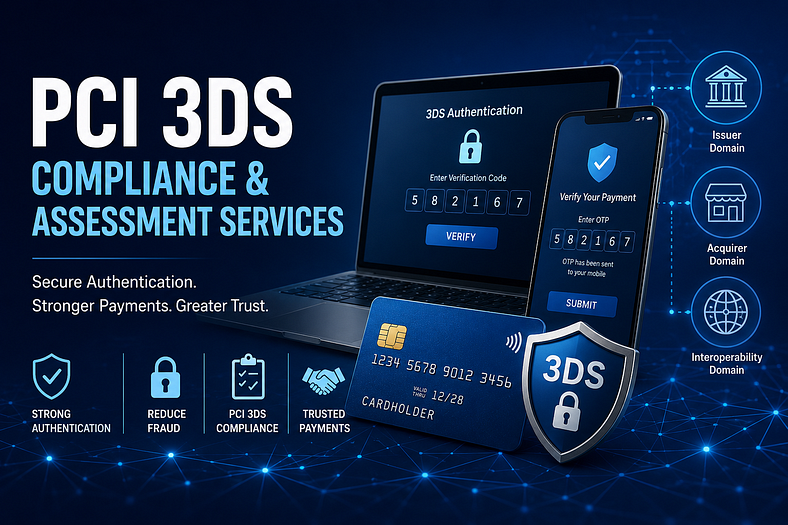
As e-commerce continues to grow, so does the risk of online payment fraud. Card-not-present (CNP) transactions have become a major target for cybercriminals because physical cards are not required during online purchases. To address these risks, the payment industry introduced 3D Secure (3DS) — an authentication protocol that adds an extra layer of security during online card transactions.
However, implementing 3D Secure alone is not enough. Organizations that host or manage 3DS components must ensure their environments meet the PCI 3DS Core Security Standard. This is where PCI 3DS Compliance & Assessment Services become essential.
This guide explains what PCI 3DS Compliance is, who needs it, its benefits, key security requirements, and how organizations can successfully prepare for a PCI 3DS assessment.
What is PCI 3DS Compliance?
PCI 3DS (Three-Domain Secure) Compliance is a security standard developed by the Payment Card Industry Security Standards Council (PCI SSC) to protect the infrastructure used for 3D Secure authentication during online payment transactions.
Unlike PCI DSS, which focuses on protecting cardholder data, PCI 3DS specifically secures the systems responsible for authenticating digital payment transactions. It ensures that authentication data, cryptographic keys, and communication between payment ecosystem participants remain protected against cyber threats.
Why PCI 3DS Compliance Matters
Online payment fraud continues to increase as digital commerce expands. Fraudsters constantly attempt to exploit weaknesses in authentication systems to perform unauthorized transactions.
PCI 3DS Compliance helps organizations:
- Secure card-not-present (CNP) transactions
- Protect authentication data throughout the payment process
- Reduce payment fraud
- Strengthen customer trust
- Meet PCI Security Standards Council requirements
- Improve audit readiness
A secure authentication environment not only protects customers but also helps financial institutions and payment providers maintain business continuity.
Understanding the Three Domains in 3D Secure
The PCI 3DS standard protects three interconnected domains involved in online payment authentication.
1. Issuer Domain
The issuing bank authenticates the cardholder and verifies the transaction.
2. Acquirer Domain
The merchant’s acquiring bank processes the payment request and communicates with the payment network.
3. Interoperability Domain
This domain connects issuers and acquirers through payment schemes, enabling secure communication between all parties.
Each domain plays a critical role in ensuring secure online payment authentication.
Who Needs PCI 3DS Compliance?
PCI 3DS Compliance primarily applies to organizations that host or manage 3DS authentication infrastructure.
These include:
- Access Control Server (ACS) providers
- Directory Server (DS) providers
- 3DS Server (3DSS) providers
- Payment service providers
- Payment gateways
- Financial institutions
- Banks
- Third-party service providers hosting 3DS environments
Any organization responsible for operating or managing 3DS authentication components should undergo PCI 3DS assessments to validate compliance.
Common Security Challenges in 3D Secure Environments
Organizations implementing 3DS often face several security challenges.
Rising Card-Not-Present Fraud
Online transactions continue to attract fraudsters due to the absence of physical card verification.
Complex Authentication Workflows
Multiple authentication steps must operate seamlessly while maintaining strong security.
Protecting Authentication Data
Sensitive authentication information must remain secure throughout the transaction lifecycle.
Managing Multiple Stakeholders
Issuers, merchants, payment gateways, and service providers all participate in the authentication process, making security management more complex.
Defining Security Scope
Organizations must clearly identify systems and infrastructure included within the PCI 3DS assessment scope.
PCI 3DS Assessment Process
A structured PCI 3DS assessment typically follows several important stages.
Scope Identification
Assessors determine which systems, servers, and authentication components fall within the PCI 3DS environment.
Architecture Assessment
Security experts review the overall architecture, authentication workflows, and data flows to identify potential risks.
Control Gap Analysis
Existing security controls are evaluated against PCI 3DS Core Security Standard requirements.
Risk Assessment and Remediation
Organizations receive recommendations to close security gaps and strengthen authentication controls.
Validation and Audit Support
Documentation is reviewed, security evidence is validated, and organizations receive support to demonstrate compliance during audits.
PCI 3DS Compliance Services
Organizations typically engage specialized compliance experts for several services.
PCI 3DS Readiness Assessment
Evaluate the existing authentication environment to identify compliance gaps.
Security Architecture Review
Assess authentication workflows, infrastructure, and data handling practices.
Compliance Gap Assessment
Identify missing controls that prevent successful certification.
Remediation Guidance
Receive practical recommendations to improve security and achieve compliance.
Audit Readiness Support
Prepare documentation, evidence, and validation materials required for successful assessments.
Benefits of PCI 3DS Compliance
Organizations that achieve PCI 3DS Compliance gain several important advantages.
Stronger Authentication Security
Protect sensitive authentication data throughout digital payment transactions.
Reduced Fraud Risk
Strengthen controls that help prevent unauthorized online transactions.
Faster Compliance Readiness
A structured compliance program simplifies assessment preparation.
Improved Customer Trust
Customers feel more confident when payment authentication is secure.
Audit-Ready Documentation
Maintain security documentation that supports faster and more efficient compliance assessments.
Alignment with PCI Security Standards
Follow globally recognized security practices established by the PCI Security Standards Council.
PCI 3DS Compliance Best Practices
Organizations can strengthen their security posture by following these best practices:
- Clearly define the PCI 3DS assessment scope.
- Secure authentication data throughout its lifecycle.
- Harden authentication servers and supporting infrastructure.
- Implement strong identity and access management controls.
- Monitor authentication systems continuously.
- Perform regular vulnerability assessments.
- Conduct penetration testing.
- Maintain detailed security documentation.
- Train employees on secure authentication processes.
- Review third-party service providers regularly.
PCI 3DS vs PCI DSS
Although both standards enhance payment security, they serve different purposes.
PCI 3DSPCI DSSProtects 3D Secure authentication infrastructureProtects cardholder dataFocuses on authentication systemsFocuses on payment data environmentsApplies to ACS, DS, and 3DS Server providersApplies to merchants, processors, and service providers handling card dataProtects authentication data and cryptographic processesProtects payment card information during storage, processing, and transmission
Many organizations operating payment infrastructures require compliance with both standards to maintain end-to-end payment security.
Industries That Benefit from PCI 3DS Compliance
PCI 3DS Compliance is valuable for organizations across the digital payments ecosystem, including:
- Banking and Financial Services
- Payment Gateways
- Payment Service Providers
- FinTech Companies
- E-commerce Platforms
- Digital Wallet Providers
- Online Marketplaces
- Third-Party Authentication Providers
These organizations rely on secure authentication to protect customers from payment fraud.
Future of PCI 3DS Compliance
As digital payments continue to evolve, authentication security will become even more important. Emerging technologies such as biometric authentication, AI-powered fraud detection, tokenization, and passwordless authentication are reshaping how organizations secure online transactions.
Future PCI 3DS requirements are expected to place greater emphasis on continuous monitoring, stronger authentication mechanisms, secure cloud environments, and proactive risk management. Organizations that invest in PCI 3DS Compliance today will be better prepared to combat emerging fraud techniques while delivering seamless and secure customer experiences.
Conclusion
Online payment fraud continues to evolve, making strong authentication more important than ever. PCI 3DS Compliance & Assessment Services help organizations secure their 3D Secure environments, protect authentication data, reduce fraud risks, and meet industry security requirements.
Rather than treating compliance as a one-time exercise, organizations should adopt a continuous security approach that includes regular assessments, ongoing monitoring, and proactive risk management. By implementing PCI 3DS best practices, businesses can strengthen their digital payment infrastructure, improve customer confidence, and stay ahead of evolving cyber threats.


Comments
Post a Comment