Virtual Agents in Customer Service: Benefits, Challenges, and Future Trends
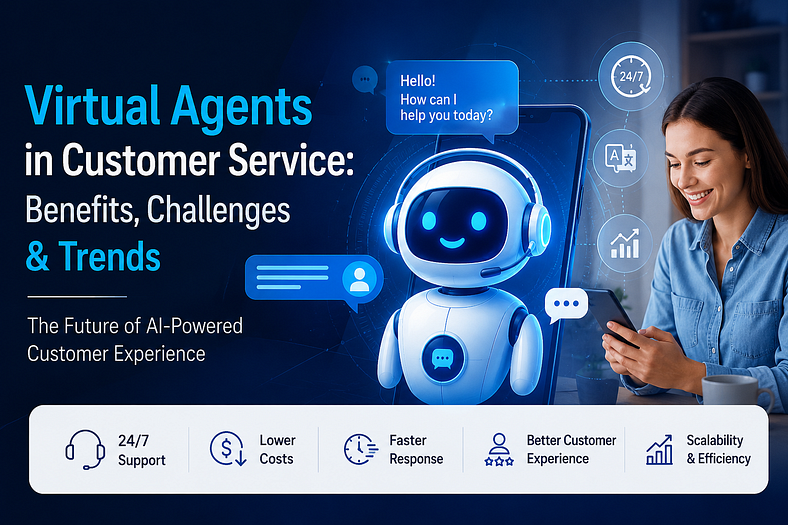
Customer expectations have evolved rapidly in the digital age. Today’s consumers expect businesses to provide instant, personalized, and seamless support across multiple channels, whether it’s a website, mobile app, social media platform, or messaging service. Meeting these expectations while managing rising customer inquiries can be challenging for organizations.
This is where virtual agents are making a significant impact. Powered by Artificial Intelligence (AI), Natural Language Processing (NLP), and Machine Learning (ML), virtual agents are transforming customer service by handling routine interactions, assisting human agents, and delivering fast, consistent support around the clock.
In this blog, we’ll explore what virtual agents are, their key benefits, common challenges, emerging trends, and how businesses can successfully implement them to enhance customer experiences.
What Are Virtual Agents?
Virtual agents are AI-powered software applications designed to interact with customers through text or voice conversations. Unlike traditional chatbots that follow predefined scripts, virtual agents can understand customer intent, maintain context, and provide more intelligent and conversational responses.
Virtual agents can assist customers with tasks such as:
- Answering frequently asked questions
- Tracking orders
- Scheduling appointments
- Resetting passwords
- Processing payments
- Troubleshooting technical issues
- Handling account-related inquiries
- Routing complex cases to live agents
By automating repetitive interactions, virtual agents free up human agents to focus on more complex customer issues.
Why Businesses Are Adopting Virtual Agents
As customer support volumes continue to grow, organizations need scalable solutions that improve service quality while controlling operational costs.
Virtual agents help businesses by:
- Providing 24/7 customer support
- Reducing customer wait times
- Improving first-contact resolution
- Lowering support costs
- Delivering consistent customer experiences
- Scaling effortlessly during peak demand
Industries such as banking, healthcare, retail, telecommunications, travel, and insurance are increasingly using virtual agents to improve customer engagement.
Key Benefits of Virtual Agents in Customer Service
1. 24/7 Customer Support
Unlike human agents, virtual agents are available around the clock. Customers can receive assistance anytime, regardless of business hours or time zones.
This improves customer satisfaction and ensures businesses never miss an opportunity to assist their customers.
2. Faster Response Times
Customers expect immediate answers to their questions.
Virtual agents can instantly respond to common inquiries, significantly reducing wait times and improving the overall customer experience.
3. Reduced Operational Costs
Hiring and training large customer support teams can be expensive.
Virtual agents automate repetitive tasks, allowing organizations to reduce operational costs while maintaining high service levels.
Human agents can focus on high-value interactions that require empathy, negotiation, or complex problem-solving.
4. Improved Customer Experience
Modern virtual agents use AI to understand customer intent and provide personalized responses based on previous interactions.
This creates more natural conversations and helps customers resolve issues quickly.
Personalized support increases customer satisfaction and builds long-term loyalty.
5. Consistent Service Quality
Human responses can vary depending on experience, workload, or fatigue.
Virtual agents deliver consistent information every time, ensuring customers receive accurate answers regardless of when they contact support.
6. Better Scalability
During product launches, holiday sales, or unexpected service disruptions, customer inquiries can increase dramatically.
Virtual agents can manage thousands of simultaneous conversations without affecting response quality or speed.
This scalability helps businesses maintain excellent customer service during peak periods.
7. Multilingual Customer Support
Many AI-powered virtual agents support multiple languages, enabling businesses to serve global customers without significantly expanding their workforce.
Customers can interact in their preferred language, improving accessibility and engagement.
Common Challenges of Virtual Agents
While virtual agents offer many advantages, organizations should also consider potential challenges.
Limited Understanding of Complex Issues
Some customer requests involve multiple steps or require emotional understanding.
Virtual agents may struggle with highly technical problems or situations requiring human judgment.
Integration with Existing Systems
Virtual agents need access to CRM platforms, knowledge bases, payment systems, and customer databases.
Poor integration can limit their effectiveness and create inconsistent customer experiences.
Data Privacy and Security
Virtual agents often process sensitive customer information.
Organizations must implement strong security measures, encryption, and access controls to protect customer data and comply with privacy regulations.
Customer Acceptance
Some customers still prefer speaking with human agents.
Businesses should offer seamless transitions from virtual agents to live representatives whenever needed.
Continuous Training
AI models require ongoing updates and training to understand new products, services, and customer behaviors.
Regular optimization ensures virtual agents remain accurate and effective.
Best Practices for Implementing Virtual Agents
Organizations can maximize the value of virtual agents by following these best practices:
- Clearly define automation goals
- Start with high-volume, repetitive customer inquiries
- Integrate virtual agents with CRM and support platforms
- Maintain an updated knowledge base
- Monitor customer feedback and performance metrics
- Enable smooth handoffs to human agents
- Continuously train AI models with real customer interactions
These practices help organizations deliver reliable and efficient customer support.
Emerging Trends in Virtual Agents
Generative AI Integration
Generative AI enables virtual agents to provide more natural, context-aware, and human-like conversations, improving customer engagement and resolution rates.
Voice-Based Virtual Agents
AI-powered voice assistants are becoming increasingly popular in contact centers, allowing customers to resolve issues through natural conversations over the phone.
Emotion Detection
Advanced AI technologies can analyze customer sentiment and emotional cues, enabling virtual agents to adjust responses and escalate sensitive conversations to human agents when appropriate.
Omnichannel Support
Modern virtual agents can maintain conversation history across websites, mobile apps, email, messaging platforms, and social media.
Customers enjoy seamless experiences without repeating information.
Predictive Customer Support
AI can anticipate customer needs based on behavior, purchase history, and previous interactions.
Virtual agents can proactively recommend solutions before customers even ask for help.
Measuring the Success of Virtual Agents
Businesses should track key performance indicators (KPIs) to evaluate the effectiveness of virtual agents, including:
- Customer Satisfaction (CSAT)
- Net Promoter Score (NPS)
- First Contact Resolution (FCR)
- Average Response Time
- Average Handle Time (AHT)
- Containment Rate
- Escalation Rate
- Customer Effort Score (CES)
- Resolution Time
- Cost per Interaction
Regular monitoring helps organizations identify improvement opportunities and optimize customer service performance.
How 24/7.ai Enhances Virtual Agent Experiences
Organizations looking to modernize customer support need AI solutions that go beyond basic automation. 24/7.ai combines conversational AI, intelligent virtual agents, automation, and analytics to deliver personalized, scalable, and always-on customer experiences. By integrating AI with human expertise, businesses can improve response times, increase customer satisfaction, and empower agents to focus on more complex interactions.
The Future of Virtual Agents
Virtual agents are evolving rapidly with advancements in artificial intelligence, natural language understanding, and machine learning. Future virtual agents will become more conversational, emotionally aware, multilingual, and capable of handling increasingly complex customer requests.
Rather than replacing human agents, they will continue to work alongside them, automating repetitive tasks while enabling customer service teams to focus on empathy, relationship-building, and problem-solving.
Organizations that embrace intelligent virtual agents today will be better positioned to meet rising customer expectations and deliver exceptional support experiences in the years ahead.
Conclusion
Virtual agents have become an essential part of modern customer service strategies. They provide faster responses, 24/7 availability, cost savings, and consistent support while helping businesses scale their operations efficiently.
Although challenges such as system integration, privacy, and handling complex inquiries remain, advancements in AI are making virtual agents more capable every year. By combining virtual agents with skilled human support teams and continuously refining AI capabilities, organizations can deliver seamless, personalized, and efficient customer experiences that drive long-term loyalty and business growth.
Frequently Asked Questions (FAQs)
1. What is a virtual agent in customer service?
A virtual agent is an AI-powered application that interacts with customers through text or voice, answering questions, resolving issues, and automating routine support tasks.
2. How are virtual agents different from chatbots?
Traditional chatbots typically follow predefined rules, while virtual agents use AI, NLP, and machine learning to understand intent, maintain context, and deliver more intelligent conversations.
3. What are the main benefits of virtual agents?
They provide 24/7 support, faster response times, reduced operational costs, consistent service, improved customer experiences, and the ability to handle high volumes of inquiries.
4. Which industries benefit from virtual agents?
Industries such as banking, retail, healthcare, insurance, telecommunications, travel, hospitality, and e-commerce widely use virtual agents to enhance customer support.
5. Can virtual agents replace human customer service agents?
No. Virtual agents are designed to complement human agents by handling repetitive tasks, while complex, sensitive, or emotionally driven interactions are best managed by human representatives.


Comments
Post a Comment