7 Powerful Examples of AI Agents Transforming Customer Service
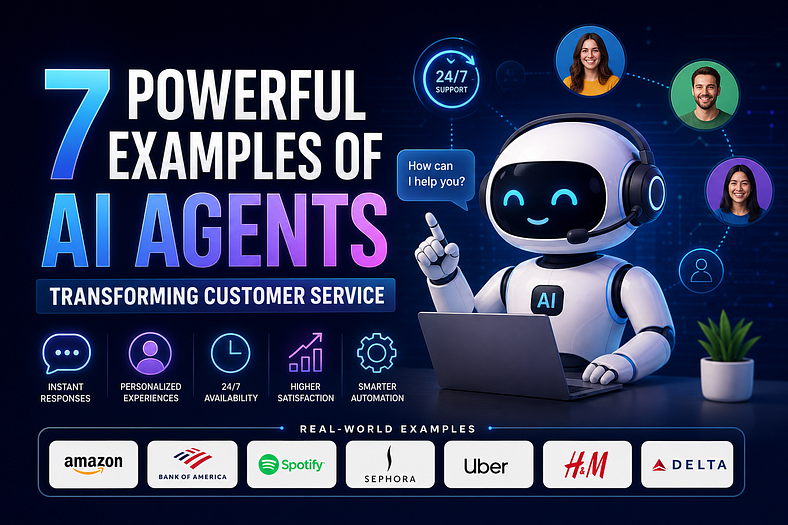
Artificial Intelligence is no longer just a futuristic concept — it’s actively reshaping how businesses interact with customers every single day. From handling support tickets instantly to delivering personalized shopping experiences, AI agents are helping brands improve customer satisfaction, reduce response times, and operate more efficiently.
In this blog, we’ll explore seven real-world examples of AI agents in customer service and how companies are using them to create faster, smarter, and more human-like customer interactions.
What Are AI Agents in Customer Service?
AI agents are intelligent software systems designed to interact with customers, solve problems, answer questions, and automate repetitive support tasks. Unlike traditional chatbots, modern AI agents can understand context, learn from interactions, and provide personalized assistance across multiple channels.
These AI-powered systems are commonly used in:
- Live chat support
- Voice assistants
- Email automation
- Ticket management
- Personalized recommendations
- Self-service portals
As businesses focus more on customer experience, AI agents are becoming a key part of modern support strategies.
1. Amazon’s AI-Powered Customer Support
Amazon uses AI agents extensively to streamline customer service operations. Their AI systems help customers track orders, process returns, answer product-related queries, and even recommend solutions before a customer contacts support.
Key Benefits
- Faster issue resolution
- 24/7 customer support
- Reduced workload for human agents
- Personalized shopping assistance
Amazon’s AI-driven support helps millions of users get instant responses without waiting in long support queues.
2. Bank of America’s Virtual Assistant “Erica”
Bank of America introduced Erica, an AI-powered virtual financial assistant that helps users manage banking activities through mobile devices.
Erica can:
- Check account balances
- Monitor spending habits
- Send bill payment reminders
- Detect unusual activity
- Offer financial insights
This AI agent improves customer convenience while reducing pressure on banking support teams.
3. Spotify’s Personalized Recommendation AI
Spotify uses advanced AI systems to understand listening habits and recommend songs, playlists, and podcasts tailored to each user.
Although it’s primarily known for recommendations, Spotify’s AI also enhances customer experience by:
- Improving content discovery
- Predicting user preferences
- Offering mood-based playlists
- Personalizing app interactions
This creates a highly engaging and customer-centric experience.
4. Sephora’s AI Beauty Assistant
Sephora leverages AI agents to improve online shopping experiences for beauty customers. Their virtual assistant helps users discover products based on skin tone, preferences, and makeup goals.
- Virtual product try-ons
- Personalized beauty recommendations
- Instant support for product queries
- Guided shopping experiences
This combination of AI and personalization increases customer confidence and boosts conversions.
5. Uber’s AI Support Automation
Uber uses AI agents to manage millions of customer interactions daily. From ride tracking to fare disputes and driver support, AI helps automate routine customer service tasks efficiently.
How Uber Uses AI
- Automated trip issue resolution
- Real-time ride tracking support
- Fraud detection systems
- Driver assistance tools
AI automation enables Uber to handle large-scale customer support operations with speed and accuracy.
6. H&M’s AI Shopping Assistant
Fashion retailer H&M uses AI-powered assistants to help customers discover outfits and fashion products based on personal preferences.
The AI system asks users style-related questions and then recommends products accordingly.
Benefits
- Personalized shopping experience
- Faster product discovery
- Improved customer engagement
- Higher purchase conversions
This creates a more interactive and customer-friendly online shopping journey.
7. Delta Airlines’ AI Travel Support
Delta Airlines uses AI agents to improve travel assistance for passengers. Their systems help customers with flight updates, baggage tracking, booking assistance, and travel notifications.
AI Features in Action
- Real-time flight alerts
- Automated baggage assistance
- Instant customer support
- Self-service travel management
This reduces customer frustration during travel disruptions and improves overall passenger experience.
Why Businesses Are Investing in AI Agents
AI agents are becoming essential because customers now expect:
- Instant responses
- Personalized experiences
- 24/7 availability
- Faster issue resolution
Businesses that implement AI customer service solutions can:
- Reduce operational costs
- Increase customer satisfaction
- Improve response efficiency
- Scale support operations easily
AI doesn’t replace human agents entirely — instead, it helps support teams focus on complex and high-value customer interactions.
The Future of AI in Customer Service
The future of customer service is becoming increasingly AI-driven. Advanced AI agents powered by Generative AI and Natural Language Processing (NLP) are expected to become more conversational, predictive, and emotionally intelligent.
Future AI customer support systems may include:
- Hyper-personalized conversations
- Emotion-aware AI responses
- Voice-first customer support
- Fully autonomous support workflows
- Multilingual real-time assistance
Companies adopting AI early will have a major advantage in delivering seamless customer experiences.
Final Thoughts
AI agents are no longer experimental technologies — they are already transforming customer service across industries. Whether it’s banking, retail, travel, or e-commerce, businesses are using AI to provide faster, smarter, and more personalized support experiences.
As AI technology continues to evolve, customer service will become more efficient, proactive, and customer-centric than ever before.


Comments
Post a Comment