How Voice AI Agents Work and Why They Are Transforming Businesses
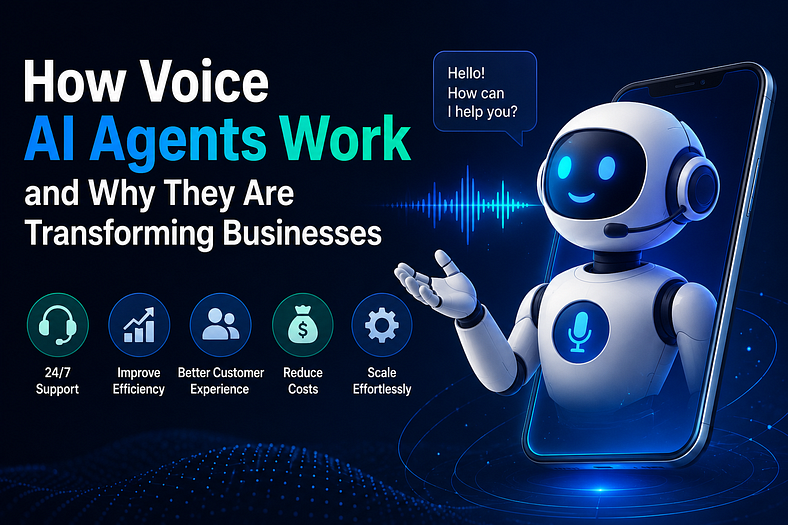
Voice AI agents are rapidly changing the way businesses interact with customers. From answering support calls to booking appointments and handling sales inquiries, these intelligent systems are making communication faster, smarter, and more efficient.
But what exactly is a Voice AI agent, and how does it work?
What Is a Voice AI Agent?
A Voice AI agent is an artificial intelligence system that can understand human speech, respond naturally, and complete tasks through voice conversations. Unlike traditional automated phone systems that rely on fixed menu options, Voice AI agents can hold dynamic, human-like conversations in real time.
These systems are powered by technologies such as speech recognition, natural language processing (NLP), and machine learning. Together, they allow the AI to listen, understand intent, process information, and generate accurate spoken responses.
Today, Voice AI agents are used in industries like healthcare, banking, customer support, e-commerce, automotive, and hospitality.
How Does a Voice AI Agent Work?
A Voice AI agent works in several steps:
1. Speech Recognition
The AI first listens to the user’s voice and converts spoken words into text. This process is called Automatic Speech Recognition (ASR).
For example, if a customer says:
“I want to book a service appointment for tomorrow,”
the system converts that sentence into readable text.
2. Understanding the Request
Next, Natural Language Processing (NLP) analyzes the meaning behind the sentence. The AI identifies the user’s intent, keywords, and context.
In this case, the AI understands that the customer wants to schedule an appointment.
3. Processing the Information
The system then checks databases, schedules, or connected software platforms to find available slots or required information.
It can also access CRM systems, calendars, inventory platforms, or customer history to provide personalized responses.
4. Generating a Response
After processing the request, the AI creates a natural response. Text-to-Speech (TTS) technology converts the AI-generated text into a human-like voice.
The user then hears something like:
“Sure, we have availability tomorrow at 11 AM or 3 PM. Which time works for you?”
Key Benefits of Voice AI Agents
Faster Customer Support
Voice AI agents can answer customer queries instantly without long waiting times.
24/7 Availability
Unlike human agents, AI systems can operate around the clock and handle calls anytime.
Reduced Operational Costs
Businesses can automate repetitive tasks and reduce dependency on large support teams.
Improved Customer Experience
Modern Voice AI agents sound natural and provide personalized responses, improving user satisfaction.
Scalability
AI systems can manage thousands of conversations simultaneously during peak hours.
Industries Using Voice AI
Healthcare
Hospitals and clinics use Voice AI for appointment scheduling, reminders, and patient support.
Banking & Finance
Banks use AI voice systems for balance inquiries, fraud alerts, and customer assistance.
E-commerce
Online businesses use Voice AI for order tracking, returns, and product recommendations.
Automotive
Car brands and EV companies use voice assistants for customer support, vehicle controls, and showroom inquiries.
Challenges of Voice AI
While Voice AI technology is improving rapidly, there are still some challenges:
- Understanding different accents and languages
- Handling complex emotional conversations
- Data privacy and security concerns
- Maintaining human-like conversation quality
However, advancements in AI models are helping solve many of these limitations.
The Future of Voice AI Agents
Voice AI is expected to become a major part of customer communication in the coming years. As AI voices become more natural and intelligent, businesses will increasingly rely on automated voice systems for sales, support, and engagement.
Future Voice AI agents may offer:
- Real-time multilingual conversations
- Emotion detection
- Personalized voice interactions
- Smarter business automation
With rapid growth in generative AI and conversational technology, Voice AI agents are no longer just a trend — they are becoming an essential business tool.
Final Thoughts
Voice AI agents are transforming how businesses communicate with customers by making interactions faster, smarter, and more accessible. From customer service to sales automation, these systems are helping companies improve efficiency while delivering better user experiences.
As technology continues to evolve, Voice AI will likely become a standard part of digital communication across industries.


Comments
Post a Comment