Agentic AI vs Conversational AI: Key Differences, Features & Real-World Use Cases
Introduction
Artificial intelligence is transforming how businesses interact with customers, automate operations, and improve decision-making. Among the latest AI innovations, Agentic AI and Conversational AI are two technologies gaining significant attention. While they may seem similar, they serve different purposes and offer distinct capabilities.
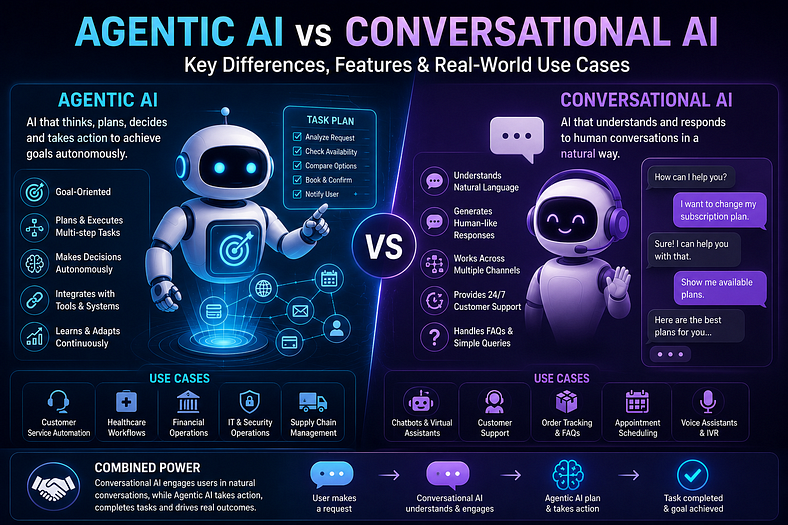
Conversational AI is designed to communicate naturally with users through text or voice, making it ideal for chatbots, virtual assistants, and customer support. Agentic AI, on the other hand, goes beyond conversations by planning, reasoning, making decisions, and completing tasks autonomously.
Understanding the differences between these two AI technologies is essential for organizations looking to improve customer experiences, automate workflows, and maximize operational efficiency.
In this guide, we’ll compare Agentic AI and Conversational AI, explore their features, benefits, use cases, and help you determine which solution is right for your business.
What is Conversational AI?
Conversational AI is a type of artificial intelligence that enables computers to communicate with humans using natural language. It combines technologies such as Natural Language Processing (NLP), Machine Learning (ML), and Large Language Models (LLMs) to understand user queries and generate human-like responses.
Businesses commonly use Conversational AI in:
- AI chatbots
- Virtual assistants
- Customer service platforms
- Voice assistants
- Interactive Voice Response (IVR) systems
- Messaging applications
Its primary goal is to improve communication by providing fast, accurate, and personalized responses to customer inquiries.
What is Agentic AI?
Agentic AI represents the next generation of artificial intelligence. Instead of simply responding to questions, Agentic AI can understand goals, create execution plans, make decisions, interact with multiple software systems, and complete complex tasks with minimal human intervention.
For example, if a customer wants to reschedule a flight, Agentic AI can:
- Check available flights
- Compare prices
- Update bookings
- Notify the customer
- Update their calendar
- Process payments if required
Rather than stopping after answering a question, Agentic AI works until the objective is achieved.
Agentic AI vs Conversational AI: Key Differences
FeatureConversational AIAgentic AIPrimary PurposeHuman-like conversationsGoal-oriented task executionInteractionResponds to user promptsPlans and completes tasksDecision MakingLimitedAutonomousWorkflow ExecutionBasicAdvancedMulti-Step PlanningMinimalYesTool IntegrationLimitedExtensiveContext AwarenessModerateHighHuman InterventionFrequently requiredMinimalAdaptabilityModerateDynamicBusiness ValueBetter communicationEnd-to-end automation
The biggest difference is that Conversational AI focuses on communication, while Agentic AI focuses on achieving outcomes.
How Conversational AI Works
Conversational AI follows a relatively straightforward process:
- Receives a customer query.
- Understands the intent using NLP.
- Searches for relevant information.
- Generates a response.
- Delivers the answer.
The interaction usually ends after responding unless the user asks another question.
How Agentic AI Works
Agentic AI performs a much broader workflow:
- Understands the user’s goal.
- Breaks the goal into smaller tasks.
- Creates an execution plan.
- Accesses enterprise systems and tools.
- Makes decisions based on available information.
- Executes multiple actions.
- Monitors progress.
- Adapts if conditions change.
- Completes the objective.
This makes Agentic AI far more capable of handling complex business operations.
Key Features of Conversational AI
Natural Language Understanding
Interprets human language accurately.
Human-Like Conversations
Provides personalized and context-aware responses.
Omnichannel Support
Works across websites, mobile apps, WhatsApp, email, SMS, and voice channels.
24/7 Availability
Offers continuous customer support without human agents.
Multilingual Communication
Supports conversations in multiple languages.
Key Features of Agentic AI
Autonomous Decision-Making
Makes intelligent decisions independently.
Multi-Step Planning
Creates execution plans before taking action.
Tool Integration
Connects with CRM systems, ERP platforms, APIs, databases, cloud applications, and business software.
Adaptive Learning
Adjusts workflows based on changing conditions.
Continuous Goal Tracking
Works until the assigned objective is completed.
Benefits of Conversational AI
Organizations implementing Conversational AI enjoy several advantages:
- Faster customer support
- Reduced response times
- Lower operational costs
- Improved customer satisfaction
- Consistent user experiences
- Higher agent productivity
- 24/7 customer engagement
It is particularly valuable for businesses handling high volumes of customer interactions.
Benefits of Agentic AI
Agentic AI offers broader operational benefits:
- End-to-end workflow automation
- Faster business processes
- Reduced manual effort
- Improved decision-making
- Greater operational efficiency
- Lower business costs
- Higher scalability
- Better business outcomes
Instead of automating conversations, it automates complete business processes.
Real-World Use Cases
Conversational AI Use Cases
Businesses commonly use Conversational AI for:
- Customer support chatbots
- Virtual banking assistants
- Appointment scheduling
- Frequently Asked Questions (FAQs)
- Order tracking
- IT help desk support
- Voice assistants
Agentic AI Use Cases
Agentic AI is transforming enterprise automation through:
Customer Service
Automatically resolving support tickets, processing refunds, updating CRM records, and scheduling follow-ups.
Healthcare
Managing patient appointments, clinical documentation, insurance verification, and care coordination.
Financial Services
Processing loans, detecting fraud, verifying identities, and generating financial reports.
Cybersecurity
Investigating security alerts, responding to incidents, and automating threat detection.
Supply Chain
Managing inventory, forecasting demand, optimizing logistics, and coordinating suppliers.
Human Resources
Screening resumes, scheduling interviews, onboarding employees, and answering HR queries.
Which AI Should Your Business Choose?
The right choice depends on your business goals.
Choose Conversational AI if you want to:
- Improve customer communication.
- Automate FAQs.
- Deploy AI chatbots.
- Enhance customer service.
- Provide voice or messaging support.
Choose Agentic AI if you want to:
- Automate complete workflows.
- Reduce manual operations.
- Improve operational efficiency.
- Connect multiple enterprise systems.
- Enable autonomous business processes.
Many organizations combine both technologies to create a seamless customer experience.
Can Agentic AI and Conversational AI Work Together?
Yes. In fact, many modern AI platforms integrate both technologies.
A typical workflow might look like this:
- A customer asks a chatbot to change a subscription plan.
- Conversational AI understands the request and communicates naturally.
- Agentic AI checks account details, verifies eligibility, updates the subscription, processes billing changes, sends a confirmation email, and records the activity in the CRM.
This combination delivers both excellent customer interactions and efficient backend automation.
Future of AI: From Conversations to Autonomous Actions
The future of enterprise AI lies in combining intelligent conversations with autonomous execution. As businesses adopt more advanced AI solutions, Agentic AI will increasingly handle complex workflows, while Conversational AI will continue to serve as the primary interface for customer engagement.
Together, these technologies will enable faster decision-making, personalized experiences, and highly automated business operations across industries such as healthcare, finance, retail, telecommunications, and customer service.
Conclusion
Both Agentic AI and Conversational AI play important roles in the future of business automation, but they address different challenges. Conversational AI excels at engaging users through natural conversations, making it ideal for customer support, virtual assistants, and chatbots. Agentic AI takes automation a step further by planning, reasoning, making decisions, and executing complex tasks with minimal human intervention.
Rather than viewing them as competing technologies, organizations should consider how they complement each other. By combining the communication capabilities of Conversational AI with the autonomous execution of Agentic AI, businesses can create smarter, faster, and more efficient customer experiences while streamlining operations and driving long-term growth.


Comments
Post a Comment