PCI Secure Software Standard (PCI S3): A Complete Guide to Secure Payment Software Compliance
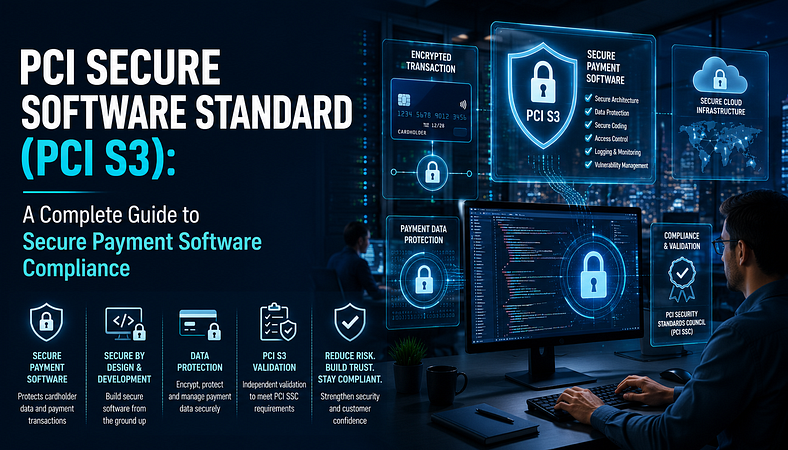
In today’s digital payment ecosystem, software security is just as important as network and infrastructure security. Payment applications process millions of transactions every day, making them a prime target for cybercriminals seeking to steal sensitive cardholder data. As payment technologies evolve, software vendors need a modern security framework that ensures their applications are designed, developed, and maintained securely.
This is where the PCI Secure Software Standard (PCI S3) comes in. Part of the PCI Software Security Framework (SSF), PCI S3 helps software vendors build secure payment applications that protect payment transactions and cardholder data throughout the software lifecycle. It also replaced the legacy Payment Application Data Security Standard (PA-DSS) to better support modern development practices such as cloud-native applications, DevSecOps, and continuous integration.
In this guide, we’ll explain what PCI S3 is, why it matters, who needs it, the validation process, and how organizations can achieve compliance.
What Is PCI S3 (Secure Software Standard)?
The PCI Secure Software Standard (PCI S3) is a security standard developed by the PCI Security Standards Council (PCI SSC). It establishes security requirements for payment software to ensure applications are securely designed, developed, tested, and maintained while protecting payment data and transaction integrity.
Unlike traditional compliance standards that focus on infrastructure, PCI S3 specifically evaluates the security of the payment software itself, including how it handles cardholder data, authentication, encryption, logging, and vulnerability management.
Why PCI S3 Is Important
Payment software is constantly exposed to evolving cyber threats, including malware, application vulnerabilities, API attacks, and supply chain compromises. A single weakness in payment software can expose sensitive customer information and lead to costly data breaches.
PCI S3 helps organizations:
- Secure payment applications against modern cyber threats
- Protect cardholder and payment data
- Improve customer trust
- Reduce security risks
- Demonstrate compliance with PCI SSC requirements
- Support secure software development practices
By validating payment software against PCI S3 requirements, software vendors provide customers with greater confidence that their applications meet recognized industry security standards.
PCI S3 Replaces PA-DSS
For many years, payment applications were assessed under PA-DSS (Payment Application Data Security Standard). However, software development practices have changed significantly with the adoption of cloud platforms, agile development, APIs, and continuous delivery.
PCI S3 officially replaced PA-DSS as part of the PCI Software Security Framework (SSF), providing a more flexible and modern approach to securing payment software.
Who Needs PCI S3 Validation?
PCI S3 is primarily intended for organizations that develop payment software used by merchants, payment processors, financial institutions, or service providers.
Organizations that typically require PCI S3 validation include:
- Payment software vendors
- Payment gateway providers
- POS software developers
- Payment application developers
- FinTech companies
- Payment solution providers
- SaaS providers offering payment applications (when eligible)
The standard demonstrates that payment software securely processes, stores, and transmits payment card information.
Key Security Areas Covered by PCI S3
PCI S3 evaluates multiple aspects of payment software security, including:
Secure Application Design
Software architecture should be designed to minimize security risks and protect sensitive payment information.
Secure Authentication
Applications must implement strong authentication mechanisms to prevent unauthorized access.
Data Protection
Sensitive payment data must be protected using approved encryption techniques during storage and transmission.
Secure Coding
Developers should follow secure coding practices that reduce common vulnerabilities such as SQL injection, cross-site scripting (XSS), and buffer overflows.
Logging and Monitoring
Applications should maintain detailed security logs to detect suspicious activity and support incident investigations.
Vulnerability Management
Organizations must regularly identify, assess, and remediate security vulnerabilities before software is released.
These controls help ensure payment software remains resilient against evolving cyber threats.
PCI S3 Validation Process
Achieving PCI S3 validation involves a structured assessment process.
1. Scope Assessment
Security experts determine whether the payment application falls within PCI S3 requirements and identify all relevant software components.
2. Architecture Review
The application’s architecture, payment data flows, interfaces, and trust boundaries are analyzed to verify secure handling of payment information.
3. Gap Assessment
Existing security controls are compared against PCI S3 requirements to identify compliance gaps.
4. Remediation
Organizations address identified issues by strengthening security controls, improving documentation, and resolving vulnerabilities.
5. Formal Validation
A qualified assessor reviews the application, validates compliance, and prepares documentation for PCI SSC listing if all requirements are met.
Benefits of PCI S3 Compliance
Implementing PCI S3 provides several business and security advantages.
Improved Payment Security
Applications are better protected against modern cyber threats targeting payment systems.
Stronger Customer Confidence
Customers gain greater trust in software that has been independently validated against globally recognized payment security standards.
Better Regulatory Readiness
Organizations demonstrate their commitment to industry best practices and payment security compliance.
Reduced Risk of Data Breaches
Secure software development and regular security assessments help minimize vulnerabilities before attackers can exploit them.
Competitive Advantage
PCI S3 validation can differentiate payment software vendors in a competitive market by demonstrating security and compliance.
PCI S3 vs PCI Secure SLC
Although both standards belong to the PCI Software Security Framework, they focus on different areas.
PCI S3PCI Secure SLCFocuses on the security of the payment softwareFocuses on the software development lifecycleEvaluates software features and security controlsEvaluates development processes and security governanceValidates the payment applicationValidates the vendor’s development practices
Many software vendors pursue both standards to demonstrate secure software products and mature development processes.
Best Practices for PCI S3 Readiness
Organizations preparing for PCI S3 validation should:
- Adopt secure coding practices
- Perform regular penetration testing
- Conduct secure architecture reviews
- Encrypt sensitive payment data
- Maintain detailed documentation
- Implement vulnerability management processes
- Monitor software continuously for security issues
- Train developers on secure software development
- Perform regular internal security assessments
These practices not only support compliance but also strengthen overall software security.
Why Work with PCI S3 Assessment Experts?
Preparing for PCI S3 validation can be challenging due to the technical and documentation requirements involved. Experienced assessment partners help organizations:
- Define the correct assessment scope
- Identify compliance gaps
- Review software architecture
- Recommend remediation strategies
- Prepare documentation and evidence
- Support formal PCI S3 validation
Working with experienced assessors can reduce project timelines and improve validation readiness.
Conclusion
As payment software becomes increasingly sophisticated, protecting payment data requires more than traditional security controls. The PCI Secure Software Standard (PCI S3) provides a comprehensive framework for designing, developing, testing, and maintaining secure payment applications that meet modern cybersecurity expectations.
Whether you’re a payment software vendor, fintech company, or payment solution provider, achieving PCI S3 validation demonstrates your commitment to protecting payment transactions, reducing security risks, and building customer trust. By adopting secure development practices and aligning with PCI S3 requirements, organizations can deliver resilient payment software that is prepared for today’s evolving threat landscape.


Comments
Post a Comment