What is Agentic AI? Definition, Features, Benefits & Differentiators
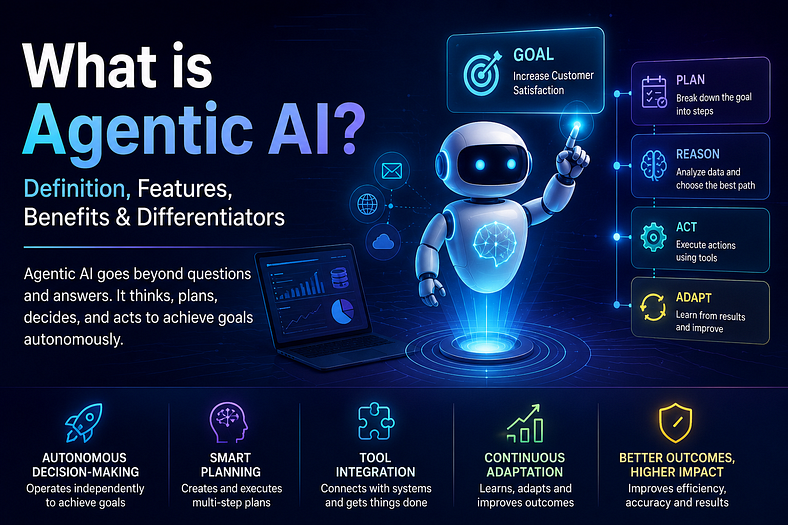
Artificial Intelligence (AI) is evolving rapidly, moving beyond simple automation and chatbots to systems capable of making decisions, planning tasks, and taking action with minimal human intervention. One of the most exciting developments in this space is Agentic AI.
Unlike traditional AI systems that simply respond to prompts, Agentic AI can understand objectives, create execution plans, interact with software and tools, and continuously improve its actions based on feedback. This shift is transforming industries such as customer service, healthcare, finance, cybersecurity, software development, and enterprise automation.
In this guide, we’ll explore what Agentic AI is, how it works, its key features, benefits, real-world use cases, and how it differs from traditional AI systems.
What is Agentic AI?
Agentic AI refers to artificial intelligence systems that can independently pursue goals, make decisions, plan multi-step tasks, and take actions to achieve specific objectives with limited human intervention.
Rather than simply answering questions or generating content, Agentic AI behaves more like an intelligent digital assistant capable of reasoning, adapting, and executing complex workflows.
For example, instead of just recommending travel destinations, an Agentic AI system could:
- Compare flights
- Book hotels
- Schedule transportation
- Update your calendar
- Send confirmation emails
- Adjust plans if flights are delayed
All while keeping your original goal in mind.
How Does Agentic AI Work?
Agentic AI combines several advanced AI technologies into one intelligent system.
The typical workflow includes:
Goal Understanding
The AI first interprets the user’s objective rather than focusing only on individual instructions.
Planning
It creates a sequence of tasks needed to achieve the goal.
Reasoning
The AI evaluates multiple options before deciding the best course of action.
Action Execution
It interacts with applications, APIs, databases, websites, and enterprise systems to complete tasks.
Continuous Learning
Based on results and feedback, the AI improves future decisions and adapts to changing situations.
This combination allows Agentic AI to perform tasks that previously required significant human involvement.
Key Features of Agentic AI
Autonomous Decision-Making
Agentic AI can make decisions without requiring constant human guidance while still operating within predefined rules and objectives.
Multi-Step Planning
Instead of responding one step at a time, it plans an entire workflow before taking action.
Context Awareness
It remembers previous interactions, understands user intent, and adapts its responses based on changing circumstances.
Tool Integration
Agentic AI can connect with:
- CRM platforms
- ERP systems
- Email applications
- Cloud services
- Databases
- APIs
- Collaboration tools
- Business software
This allows it to complete real business tasks instead of simply generating text.
Continuous Adaptation
If conditions change during execution, Agentic AI can adjust its strategy automatically.
For example, if inventory becomes unavailable, it can search for alternative suppliers without restarting the process.
Goal-Oriented Behavior
Traditional AI responds to prompts.
Agentic AI focuses on achieving outcomes.
Benefits of Agentic AI
Organizations adopting Agentic AI gain numerous operational advantages.
Increased Productivity
Routine workflows become automated, allowing employees to focus on higher-value work.
Faster Decision-Making
AI analyzes large volumes of information in seconds and recommends optimal actions.
Improved Customer Experience
Agentic AI provides faster responses, personalized recommendations, and proactive customer support.
Reduced Operational Costs
Automating repetitive business processes reduces manual effort and operational expenses.
Higher Accuracy
By minimizing manual intervention, organizations reduce human errors in business processes.
Better Business Agility
Agentic AI quickly adapts to changing business conditions without requiring complete workflow redesign.
Agentic AI vs Traditional AI
Although both technologies use artificial intelligence, they differ significantly.
FeatureTraditional AIAgentic AIPurposeResponds to promptsAchieves goalsDecision MakingLimitedAutonomousPlanningSingle-stepMulti-stepTool UsageMinimalExtensiveAdaptabilityLowHighHuman SupervisionFrequentMinimalWorkflow AutomationBasicAdvanced
Traditional AI reacts to requests, while Agentic AI proactively works toward completing objectives.
Agentic AI vs Generative AI
Many people confuse Agentic AI with Generative AI, but they serve different purposes.
Generative AIAgentic AICreates text, images, code, or videosExecutes tasks and workflowsResponds to promptsPursues goalsFocuses on content generationFocuses on decision-makingLimited execution capabilitiesCan interact with external systemsHuman-drivenGoal-driven
Generative AI can be one component of an Agentic AI system, but Agentic AI extends beyond content creation to include planning, reasoning, and execution.
Real-World Use Cases of Agentic AI
Customer Service
Agentic AI can:
- Resolve customer issues
- Escalate complex cases
- Update CRM records
- Schedule follow-ups
- Personalize responses
without requiring multiple human agents.
Healthcare
Healthcare providers use Agentic AI for:
- Appointment scheduling
- Patient monitoring
- Clinical documentation
- Treatment recommendations
- Medical workflow automation
Financial Services
Banks and financial institutions leverage Agentic AI for:
- Fraud detection
- Loan processing
- Customer onboarding
- Risk analysis
- Investment insights
Cybersecurity
Security teams use Agentic AI to:
- Detect threats
- Investigate alerts
- Respond to incidents
- Analyze vulnerabilities
- Automate security operations
Software Development
Developers benefit from Agentic AI through:
- Code generation
- Bug detection
- Automated testing
- Documentation
- Deployment assistance
Supply Chain Management
Businesses use Agentic AI to:
- Optimize inventory
- Predict demand
- Monitor shipments
- Manage suppliers
- Improve logistics planning
Challenges of Agentic AI
Despite its advantages, organizations should consider several challenges before implementation.
Governance
Autonomous systems require clear rules, oversight, and accountability.
Data Privacy
Agentic AI often accesses multiple enterprise systems, making strong security controls essential.
Integration Complexity
Connecting AI with legacy infrastructure can be technically challenging.
Ethical Decision-Making
Organizations must ensure AI decisions remain fair, transparent, and compliant with regulations.
Continuous Monitoring
Even autonomous systems require regular monitoring, auditing, and performance evaluation.
Best Practices for Implementing Agentic AI
Organizations can maximize success by following these best practices:
- Clearly define business objectives.
- Start with high-impact automation use cases.
- Implement robust security and access controls.
- Monitor AI performance continuously.
- Maintain human oversight for critical decisions.
- Train employees to collaborate effectively with AI systems.
- Regularly review AI outputs for accuracy and compliance.
Future of Agentic AI
Agentic AI is expected to become a cornerstone of enterprise digital transformation. As large language models, machine learning, robotics, and autonomous systems continue to evolve, AI agents will become increasingly capable of handling complex business operations independently.
Future advancements may include collaborative AI agents working across departments, deeper integration with enterprise software, enhanced reasoning capabilities, and greater personalization. Organizations that adopt Agentic AI responsibly will be well-positioned to improve efficiency, reduce costs, and deliver better customer experiences.
Conclusion
Agentic AI represents the next generation of artificial intelligence by moving beyond simple responses to intelligent action. Through autonomous decision-making, multi-step planning, reasoning, and seamless integration with business systems, it enables organizations to automate complex workflows and achieve meaningful business outcomes.
Whether it’s improving customer support, strengthening cybersecurity, optimizing supply chains, or accelerating software development, Agentic AI is reshaping how businesses operate. As the technology continues to mature, organizations that embrace it with strong governance and responsible implementation will gain a significant competitive advantage in an increasingly AI-driven world.


Comments
Post a Comment