AI Sentiment Analysis in Customer Service: Everything You Need to Know
Introduction
Customer service is no longer just about resolving problems. Businesses also need to understand how customers feel during every interaction. A customer may say that everything is fine while using frustrated language, or they may express satisfaction while showing signs of uncertainty.
This is where AI sentiment analysis is becoming an important customer service technology.
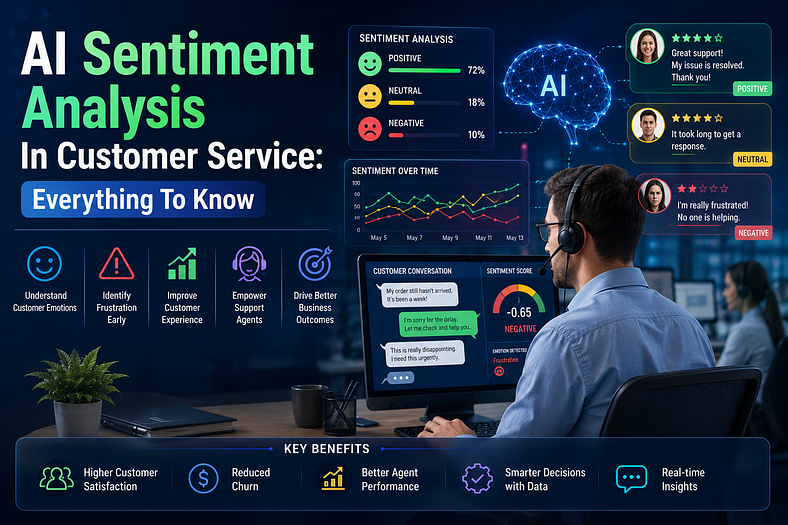
AI sentiment analysis uses artificial intelligence, natural language processing (NLP), machine learning, and speech analytics to identify emotions and opinions expressed during customer interactions. It can analyze conversations across chat, email, social media, surveys, and voice calls to determine whether a customer interaction is positive, negative, or neutral.
For customer service teams, these insights can help identify unhappy customers, improve agent performance, prioritize urgent conversations, and create more personalized experiences.
In this guide, we’ll explore what AI sentiment analysis is, how it works, its benefits, use cases, challenges, best practices, and future trends.
What Is AI Sentiment Analysis?
AI sentiment analysis is the use of artificial intelligence to analyze customer communications and determine the emotional tone or sentiment behind them.
The technology examines words, phrases, context, tone, and other signals to classify customer sentiment.
A basic sentiment analysis system may categorize interactions as:
- Positive
- Negative
- Neutral
More advanced systems can identify specific emotions and customer states, including:
- Frustration
- Anger
- Satisfaction
- Confusion
- Disappointment
- Happiness
- Urgency
- Anxiety
For example, consider these customer statements:
Positive:
“The support team resolved my issue quickly. Thank you.”
Neutral:
“Can you tell me when my order will arrive?”
Negative:
“I’ve contacted support three times and nobody has fixed my problem.”
An AI system can analyze these statements and identify the likely sentiment, helping customer service teams respond appropriately.
How Does AI Sentiment Analysis Work?
AI sentiment analysis typically involves several steps.
1. Collecting Customer Interactions
The system collects customer conversations from different channels, such as:
- Live chat
- Phone calls
- Social media
- Customer reviews
- Surveys
- Messaging applications
- Support tickets
This provides a broad view of customer sentiment.
2. Processing the Data
Natural language processing processes the text or speech to understand the customer’s language.
The system can identify important words, phrases, context, and conversational patterns.
For voice conversations, speech recognition technology can convert spoken language into text for analysis.
3. Identifying Sentiment
The AI model evaluates the conversation and determines whether the sentiment is positive, negative, or neutral.
Advanced systems can go beyond basic sentiment and identify specific emotional signals.
4. Understanding Context
Context is important because the same word can have different meanings depending on the conversation.
For example:
“Great, another delay.”
The word “great” appears positive, but the overall sentence is clearly expressing frustration.
Modern AI systems can use conversational context to better understand such statements.
5. Generating Insights
The system can then provide insights to customer service teams.
For example:
- Customer sentiment: Negative
- Primary issue: Delivery delay
- Emotion: Frustration
- Escalation required: Yes
These insights can help agents decide what action to take next.
Types of AI Sentiment Analysis
Basic Sentiment Analysis
This approach categorizes interactions into:
- Positive
- Negative
- Neutral
It is useful for monitoring overall customer satisfaction.
Emotion Detection
Advanced AI can identify specific emotions such as anger, frustration, happiness, disappointment, and confusion.
This provides deeper insights than simple positive or negative classification.
Aspect-Based Sentiment Analysis
Aspect-based sentiment analysis identifies sentiment toward specific parts of a product or service.
For example:
“The phone has an excellent camera, but the battery life is disappointing.”
AI can identify:
- Camera → Positive
- Battery → Negative
This allows businesses to understand exactly which part of the customer experience needs improvement.
Voice Sentiment Analysis
Voice sentiment analysis examines spoken conversations and can consider factors such as:
- Words
- Tone
- Speaking speed
- Pauses
- Pitch
- Conversation patterns
This can help contact centers identify customer frustration during live calls.
Benefits of AI Sentiment Analysis in Customer Service
1. Understand Customer Emotions
One of the biggest advantages is the ability to understand how customers feel throughout their interactions.
Instead of relying only on surveys or customer ratings, businesses can analyze thousands of conversations to identify emotional patterns.
2. Identify Frustrated Customers
AI can flag conversations that contain strong negative sentiment.
For example, a customer who repeatedly contacts support about the same problem may be identified as a high-risk interaction.
The business can then prioritize the conversation and provide additional assistance.
3. Improve Customer Satisfaction
Understanding customer sentiment helps businesses identify the causes of dissatisfaction.
If customers consistently express frustration about long delivery times, complicated returns, or slow support responses, the organization can take corrective action.
4. Help Agents in Real Time
Sentiment analysis can provide real-time signals to customer service agents.
For example, if a conversation becomes increasingly negative, an AI system could alert the agent to consider escalation or adjust their communication approach.
5. Improve Agent Performance
Businesses can analyze customer sentiment alongside agent performance.
This can help identify:
- Successful conversations
- Poorly handled interactions
- Training opportunities
- Communication problems
- High-performing agents
Managers can use these insights to improve coaching and training programs.
6. Reduce Customer Churn
Negative customer experiences can increase the risk of customers leaving a business.
AI sentiment analysis can identify customers showing signs of frustration or dissatisfaction, allowing companies to take proactive steps to retain them.
7. Prioritize Support Tickets
Not every customer inquiry has the same level of urgency.
AI can analyze sentiment and help support teams prioritize conversations that require immediate attention.
For example, an extremely frustrated customer with a critical service issue could be routed to an experienced support agent.
8. Analyze Large Volumes of Data
Manually analyzing thousands or millions of customer interactions is difficult.
AI can process large volumes of conversations much faster, helping businesses discover trends that might otherwise be missed.
AI Sentiment Analysis Use Cases in Customer Service
Contact Centers
Contact centers can analyze customer conversations to identify frustration, satisfaction, and escalation risks.
Managers can use these insights to improve service quality and agent performance.
E-commerce
Online retailers can analyze customer reviews, chats, and support conversations to understand opinions about:
- Products
- Delivery
- Returns
- Payments
- Customer service
This can help e-commerce companies identify problems and improve customer experiences.
Banking and Financial Services
Banks can use sentiment analysis to monitor customer interactions related to:
- Account issues
- Transactions
- Loans
- Credit cards
- Fraud concerns
Negative sentiment can help identify conversations that require additional attention.
Healthcare
Healthcare organizations can analyze patient communications to understand satisfaction with:
- Appointment scheduling
- Administrative support
- Communication
- Billing
- Patient services
Sensitive healthcare data requires appropriate privacy and security controls.
Telecommunications
Telecom companies can analyze customer conversations about:
- Network problems
- Billing
- Internet connectivity
- Service plans
- Technical support
Sentiment insights can help identify recurring sources of customer frustration.
Travel and Hospitality
Hotels, airlines, and travel companies can use AI to analyze customer feedback related to:
- Booking
- Check-in
- Flight delays
- Hotel services
- Staff interactions
This can help businesses improve service quality and customer loyalty.
AI Sentiment Analysis in Omnichannel Customer Service
Modern customers communicate with businesses through multiple channels.
A customer may begin a conversation through a chatbot, continue it through email, and later call a contact center.
AI sentiment analysis can analyze interactions across these channels to provide a broader view of the customer journey.
For example:
Chat: Customer asks about a delayed order.
Email: Customer complains about the delay.
Phone: Customer becomes frustrated after contacting support again.
An omnichannel sentiment analysis system can recognize that the customer’s frustration has increased over time.
This context can help the next agent provide more effective support.
Real-Time vs Post-Interaction Sentiment Analysis
Real-Time Sentiment Analysis
Real-time sentiment analysis analyzes conversations while they are happening.
It can alert agents when:
- Customer frustration increases
- Negative sentiment appears
- Escalation may be required
- A conversation is becoming difficult
This allows agents to respond immediately.
Post-Interaction Sentiment Analysis
Post-interaction analysis takes place after a conversation ends.
Businesses can analyze completed interactions to identify:
- Customer satisfaction trends
- Common complaints
- Agent performance
- Product issues
- Service problems
Both approaches can work together to improve customer service.
AI Sentiment Analysis vs Traditional Customer Feedback
Traditional customer feedback often relies on:
- Surveys
- Ratings
- Reviews
- Feedback forms
- Customer interviews
While these methods remain useful, they capture only a portion of customer sentiment.
AI sentiment analysis can examine much larger volumes of unstructured customer communication.
Traditional FeedbackAI Sentiment AnalysisMostly survey-basedAnalyzes conversationsLimited responsesLarge-scale analysisOften retrospectiveCan work in real timeManual analysisAutomated analysisBasic ratingsDeeper emotional insightsLimited contextConversational context
Combining traditional feedback with AI sentiment analysis can provide a more complete understanding of customer experience.
Challenges of AI Sentiment Analysis
Despite its benefits, sentiment analysis is not perfect.
Understanding Sarcasm
Sarcasm can be difficult for AI systems to interpret.
For example:
“Fantastic. My internet is down again.”
The word “fantastic” is positive on its own, but the overall sentiment is negative.
Cultural and Language Differences
Words and expressions can have different meanings across regions and cultures.
Businesses serving global customers should use models capable of handling different languages and cultural contexts.
Voice Complexity
Human speech contains many signals beyond words.
Tone, background noise, accents, interruptions, and speaking patterns can affect sentiment analysis accuracy.
Data Privacy
Customer conversations may contain personal and sensitive information.
Organizations must establish appropriate security, privacy, access controls, and data governance practices.
False Positives and Negatives
AI models can sometimes incorrectly classify sentiment.
For this reason, businesses should avoid treating sentiment scores as absolute truth, particularly for high-impact decisions.
Best Practices for Implementing AI Sentiment Analysis
Define Clear Objectives
Determine what you want sentiment analysis to achieve.
Possible objectives include:
- Reduce customer churn
- Improve agent performance
- Identify service problems
- Prioritize support tickets
- Improve customer satisfaction
Use High-Quality Data
AI models perform better when trained and evaluated using relevant, high-quality customer interaction data.
Combine Sentiment With Context
Sentiment scores should be considered alongside customer history, intent, interaction type, and business context.
Integrate With Customer Service Platforms
Connect sentiment analysis with CRM, contact center, help desk, and customer experience platforms to make insights actionable.
Keep Humans Involved
Human agents and managers should remain involved when sentiment analysis influences important customer service decisions.
Monitor Accuracy
Regularly evaluate AI performance and update models as customer language, products, and business processes change.
Key Metrics for Measuring Sentiment Analysis
Businesses can monitor several metrics to evaluate the impact of sentiment analysis.
Customer Satisfaction Score (CSAT)
Measures how satisfied customers are with an interaction.
Net Promoter Score (NPS)
Measures customer willingness to recommend a company.
Customer Effort Score (CES)
Measures how easy or difficult it was for customers to resolve an issue.
Sentiment Score
Tracks positive, negative, or neutral customer sentiment over time.
Escalation Rate
Measures how frequently conversations need to be transferred to higher-level support.
Customer Churn Rate
Helps determine whether improvements in customer sentiment are contributing to customer retention.
The Role of Generative AI in Sentiment Analysis
Generative AI is making sentiment analysis more sophisticated.
Traditional sentiment analysis may provide:
Sentiment: Negative
Generative AI can provide a more detailed explanation:
Sentiment: Negative
Emotion: Frustration
Reason: Repeated delivery delays
Customer intent: Requesting resolution
Recommended action: Escalate to delivery support and provide a revised delivery estimate
This combination of sentiment detection, contextual reasoning, and AI-generated recommendations can make customer service insights more actionable.
The Future of AI Sentiment Analysis
Sentiment analysis is likely to become more deeply integrated into customer experience platforms.
Future developments may include:
Multimodal Sentiment Analysis
AI will combine text, voice, facial expressions, and other signals where appropriate to create a broader understanding of customer emotions.
Predictive Sentiment Analysis
Instead of only identifying current emotions, AI could predict when a customer’s frustration is likely to increase.
Agentic Customer Service
AI agents could use sentiment signals to determine when to adjust workflows, escalate issues, or offer specific resolutions within authorized boundaries.
Hyper-Personalized Support
Businesses could use sentiment and customer history to tailor responses to individual customers.
Real-Time Emotion Coaching
AI could provide agents with recommendations during live conversations based on changing customer sentiment.
Conclusion
AI sentiment analysis is transforming customer service by helping businesses understand not only what customers say but also the emotions and opinions behind their words.
By analyzing conversations across voice, chat, email, social media, reviews, and support tickets, businesses can identify frustration, measure satisfaction, prioritize customer issues, improve agent performance, and uncover problems across the customer journey.
However, sentiment analysis should be treated as an intelligent decision-support capability rather than a perfect measurement of human emotion. Combining AI insights with customer context, human judgment, strong data governance, and continuous monitoring is essential.
As Generative AI and Agentic AI continue to evolve, sentiment analysis will become an increasingly important part of intelligent customer service. Businesses that use these technologies responsibly can move from simply reacting to customer complaints toward understanding customer needs earlier, delivering more personalized support, and creating better experiences at scale.


Comments
Post a Comment