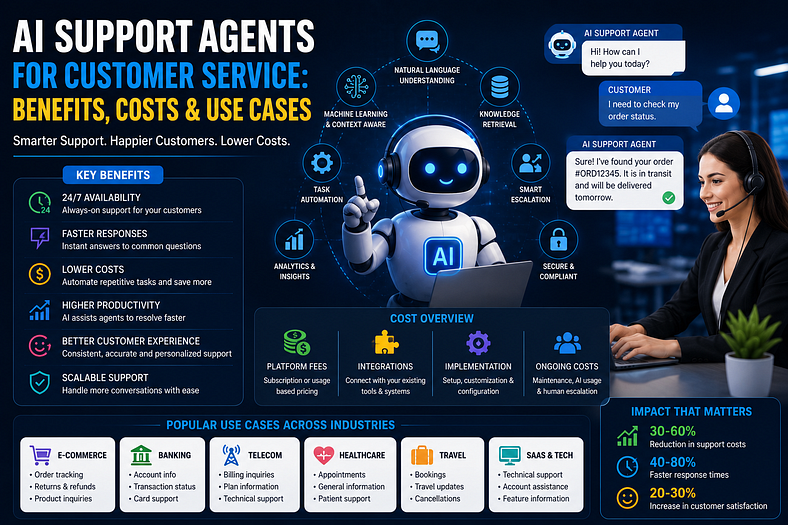
AI Support Agents for Customer Service: Benefits, Costs & Use Cases
Introduction
Customer service is evolving quickly as businesses adopt artificial intelligence to handle routine questions, support human agents, and automate customer service workflows. One of the biggest developments in this area is the rise of AI support agents.
Unlike traditional chatbots that mainly answer predefined questions, AI support agents can understand customer intent, access business information, maintain conversation context, and complete certain tasks based on the permissions given to them.
For businesses handling large volumes of customer interactions, AI support agents can provide faster responses, 24/7 availability, and greater operational efficiency.
But adopting AI support agents also raises important questions:
- What exactly is an AI support agent?
- How much does it cost?
- What are the main benefits?
- Which customer service tasks can it handle?
- When should a conversation be transferred to a human agent?
This guide explains everything businesses need to know about AI support agents for customer service, including benefits, costs, use cases, implementation considerations, and future trends.
What Are AI Support Agents?
AI support agents are artificial intelligence systems designed to interact with customers and perform customer service tasks.
They use technologies such as:
- Generative AI
- Large language models (LLMs)
- Natural language processing (NLP)
- Machine learning
- Conversational AI
- Knowledge retrieval
- Workflow automation
- Speech recognition
An AI support agent can understand a customer’s request, search relevant information, generate a response, and potentially perform an authorized action.
For example, a customer might ask:
“Can you check the status of my order?”
Instead of simply providing a generic answer, an AI support agent connected to an order management system could potentially:
- Verify the customer’s information.
- Find the order.
- Check its current status.
- Provide an estimated delivery date.
- Update the customer.
- Escalate the issue if something has gone wrong.
This ability to understand, reason, retrieve information, and take action is what differentiates AI support agents from many traditional chatbots.
AI Support Agents vs Traditional Chatbots
The terms chatbot and AI agent are sometimes used interchangeably, but there are important differences.
Traditional ChatbotAI Support AgentOften rule-basedAI-drivenPredefined responsesDynamic responsesLimited contextCan maintain conversational contextUsually answers questionsCan answer and perform tasksLimited integrationsCan connect with business systemsSimple workflowsCan handle multi-step workflowsUsually reactiveCan be more task-oriented
A traditional chatbot might tell a customer how to return a product.
An AI support agent could potentially check whether the customer’s order qualifies for a return, create the return request, provide instructions, and update the relevant system.
The actual capabilities depend on the platform, integrations, permissions, and business rules.
How Do AI Support Agents Work?
AI support agents generally operate through several interconnected components.
1. Customer Interaction
The customer starts a conversation through a channel such as:
- Website
- Mobile application
- Live chat
- Messaging platform
- Voice call
- Social media
2. Intent Understanding
The AI analyzes the customer’s language to understand what they want.
For example:
“I was charged twice for my subscription.”
The AI can identify the likely intent as a duplicate billing issue.
3. Context Retrieval
The agent can retrieve relevant information from approved sources such as:
- Knowledge bases
- CRM systems
- Order management platforms
- Customer accounts
- Product documentation
- Support tickets
This allows the AI to provide more relevant answers.
4. Response Generation
The AI generates a response using the available information and business guidelines.
The response should be grounded in trusted business data rather than relying solely on the language model’s general knowledge.
5. Task Execution
If the system has the appropriate permissions and integrations, the AI agent can perform specific actions.
Examples include:
- Updating an account
- Checking an order
- Scheduling an appointment
- Creating a support ticket
- Processing an approved request
- Sending information
6. Human Escalation
If the issue is too complicated, sensitive, or outside the AI’s permissions, the conversation can be transferred to a human agent.
The AI can also provide the human agent with a conversation summary and relevant customer context.
Benefits of AI Support Agents for Customer Service
1. 24/7 Customer Support
AI support agents can operate continuously without traditional business hours.
Customers can receive assistance during:
- Nights
- Weekends
- Holidays
- Peak periods
This is particularly useful for global businesses serving customers across multiple time zones.
2. Faster Response Times
AI can respond almost immediately to many customer requests.
Instead of waiting in a queue, customers can receive an answer within seconds for straightforward questions.
Faster responses can reduce customer effort and improve the overall support experience.
3. Lower Support Costs
One of the major reasons businesses consider AI support agents is the potential to reduce the cost of handling repetitive interactions.
AI can handle high-volume, low-complexity requests while human agents focus on more valuable work.
However, AI does not eliminate all customer service costs. Businesses still need to account for implementation, integrations, AI usage, monitoring, maintenance, security, and human escalation.
4. Reduced Agent Workload
Human support representatives often spend significant time answering repetitive questions.
AI agents can handle common requests such as:
- Order status
- Password assistance
- Account information
- Product FAQs
- Appointment information
- Shipping questions
This gives human agents more time to focus on complicated cases.
5. Improved Agent Productivity
AI can work alongside human support teams.
When a conversation is transferred to an agent, AI can provide:
- Conversation summaries
- Customer history
- Suggested responses
- Relevant knowledge articles
- Recommended next steps
This can reduce the amount of time agents spend searching for information.
6. Greater Scalability
Customer service volumes can increase during:
- Product launches
- Holidays
- Promotions
- Seasonal events
- Service disruptions
AI support agents can handle multiple conversations simultaneously, allowing businesses to scale support without increasing human staffing at the same rate.
7. Consistent Customer Service
Human agents may provide different answers to similar questions.
AI support agents can use approved knowledge sources and standardized workflows to deliver more consistent information.
This is particularly useful for businesses with large customer service teams.
8. Personalized Customer Experiences
When securely connected to customer information, AI agents can provide more personalized assistance.
For example, instead of saying:
“Please check your order status.”
An AI agent could potentially identify the customer’s specific order and provide its current status.
AI Support Agent Use Cases
AI support agents can be used across many industries and customer service functions.
1. E-commerce Customer Support
E-commerce businesses can use AI agents to handle:
- Order tracking
- Returns
- Refund questions
- Product information
- Shipping queries
- Payment questions
- Account assistance
For example, an AI agent can help a customer understand where their package is without requiring a human agent to manually check the order.
2. Banking and Financial Services
AI agents can assist with routine banking requests such as:
- Account information
- Card-related questions
- Transaction inquiries
- Branch information
- General banking FAQs
Financial organizations need strong authentication, security, compliance, and access controls before allowing AI to perform account-related actions.
3. Telecommunications
Telecom companies can use AI support agents for:
- Billing questions
- Plan information
- Network troubleshooting
- Service activation
- Account assistance
- Technical support
AI can also help customers troubleshoot common connectivity problems before escalating more complex issues to technical specialists.
4. Healthcare
Healthcare organizations can use AI support agents for administrative tasks such as:
- Appointment scheduling
- Appointment reminders
- General service information
- Administrative FAQs
- Patient communication
Sensitive healthcare information requires appropriate privacy, security, and governance measures.
5. Travel and Hospitality
AI agents can assist travelers with:
- Reservations
- Booking information
- Changes and cancellations
- Hotel information
- Travel questions
- Customer requests
This can be particularly useful for businesses operating around the clock.
6. SaaS and Technology Companies
Software companies can use AI agents to support customers with:
- Product questions
- Account assistance
- Troubleshooting
- Documentation
- Subscription questions
- Basic technical issues
AI can also search technical documentation and provide step-by-step guidance.
AI Support Agents for Voice Customer Service
AI support agents are not limited to text-based interactions.
Voice AI agents can communicate with customers over telephone calls using speech recognition and conversational AI.
A voice AI agent can potentially:
- Understand what the customer says.
- Identify intent.
- Retrieve customer information.
- Provide an answer.
- Complete an authorized workflow.
- Transfer the call to a human agent when necessary.
Voice AI can be useful for high-volume contact centers where customers prefer speaking rather than typing.
AI Support Agents and Human Agents
The most effective customer service strategy is often a combination of AI and human expertise.
AI can handle:
- Repetitive questions
- Basic troubleshooting
- Information retrieval
- Routine transactions
- Ticket classification
- Simple requests
Human agents can handle:
- Complex complaints
- Sensitive situations
- Exceptions
- High-value customers
- Escalations
- Cases requiring judgment or empathy
This creates a human + AI customer service model.
Instead of replacing human agents entirely, AI can remove repetitive work and allow employees to focus on situations where human expertise creates more value.
How Much Do AI Support Agents Cost?
There is no single fixed price for an AI support agent.
The total cost depends on factors such as:
- Number of customer interactions
- AI platform
- Model usage
- Voice vs text support
- Number of channels
- CRM integrations
- Business system integrations
- Customization
- Security requirements
- Human-agent support
- Implementation services
- Monitoring and maintenance
Some vendors charge based on conversations, interactions, resolutions, usage, seats, or other pricing models.
Main AI Support Agent Cost Components
1. Platform Cost
Businesses may pay a subscription or usage-based fee for the AI customer service platform.
2. AI Usage
Costs can depend on the amount of AI processing required.
High-volume businesses should evaluate expected conversation and model usage carefully.
3. Integration Costs
Connecting an AI agent to CRM, ERP, order management, billing, or other systems may require additional development work.
4. Implementation
Organizations may need professional services to configure:
- Workflows
- Knowledge sources
- AI behavior
- Escalation rules
- Integrations
- Security controls
5. Maintenance
AI systems require continuous monitoring and optimization.
Businesses may need to update:
- Knowledge bases
- Workflows
- Policies
- Prompts
- Integrations
- Evaluation processes
6. Human Escalation
AI agents will not resolve every conversation.
Businesses should include the cost of human agents who handle escalated or complex cases.
How to Calculate AI Support Agent ROI
Businesses should evaluate AI support agents based on total business value, not simply software cost.
A basic ROI analysis can consider:
AI Investment = Platform + Implementation + Integration + Maintenance + Human Oversight
Compare this with potential benefits such as:
- Reduced cost per interaction
- Lower support volume handled by humans
- Increased agent productivity
- Faster resolution
- Higher customer satisfaction
- Reduced customer churn
For example, if an AI agent successfully handles a large percentage of repetitive customer requests, human agents can focus on more complex interactions.
The resulting productivity improvement may provide significant value even when the AI platform itself has a recurring cost.
Key Features to Look for in an AI Support Agent
Natural Language Understanding
The AI should understand how customers naturally communicate instead of relying entirely on predefined commands.
Generative AI
Generative AI can help create natural responses and summarize conversations.
Knowledge Retrieval
The agent should be able to retrieve accurate information from approved business sources.
Business Integrations
Look for integrations with:
- CRM
- Help desk
- ERP
- Order management
- Billing
- Knowledge platforms
Omnichannel Support
The platform should ideally support the channels your customers already use.
Human Handoff
Customers should have an easy way to reach a human agent when needed.
Analytics
Businesses should be able to measure:
- Resolution rate
- Escalation rate
- Customer satisfaction
- Automation rate
- Conversation volume
- AI accuracy
Security and Governance
AI agents should have clearly defined permissions and access only to the information and systems required for their tasks.
Challenges of AI Support Agents
AI support agents offer significant benefits, but businesses should understand their limitations.
Incorrect Responses
Generative AI can sometimes produce inaccurate information.
Businesses should use trusted knowledge sources, testing, monitoring, and appropriate safeguards.
Complex Customer Problems
Some customer issues require human judgment and cannot be effectively handled by automation.
Integration Challenges
AI agents become more useful when they can access business systems, but these integrations can be technically complex.
Data Privacy
Customer conversations may contain personal, financial, or other sensitive information.
Businesses need strong security and data governance practices.
Customer Trust
Some customers may prefer speaking with a human, especially when dealing with serious complaints or sensitive issues.
Providing transparent escalation options is important.
Best Practices for Implementing AI Support Agents
Start With High-Volume Requests
Begin with simple, repetitive requests that are easy to automate.
Examples include:
- FAQs
- Order tracking
- Appointment scheduling
- Password assistance
- Basic account questions
Build a Strong Knowledge Base
AI agents need reliable information.
Keep product documentation, FAQs, policies, and support content accurate and up to date.
Define AI Permissions
Clearly establish what the AI can:
- View
- Recommend
- Change
- Approve
- Execute
High-risk actions should require appropriate human approval.
Create Clear Escalation Rules
The AI should know when to transfer a conversation.
Escalation may be appropriate when:
- The customer requests a human
- The issue is highly complex
- The customer is extremely frustrated
- The AI lacks sufficient information
- The request involves a restricted action
Monitor Performance
Regularly evaluate AI conversations to identify:
- Incorrect responses
- Unresolved issues
- Escalations
- Customer dissatisfaction
- Knowledge gaps
Metrics to Measure AI Support Agent Performance
Businesses can track several KPIs.
AI Resolution Rate
Percentage of conversations resolved without human intervention.
Escalation Rate
Percentage of conversations transferred to human agents.
First Contact Resolution
Measures how often customer issues are resolved during the initial interaction.
Customer Satisfaction
Measures how customers rate their support experience.
Average Handling Time
Shows how long it takes to resolve customer interactions.
Automation Rate
Measures the proportion of eligible support tasks handled automatically.
Cost per Resolution
Helps businesses understand the financial impact of AI-powered support.
The Future of AI Support Agents
AI support agents are evolving from simple conversational systems into more capable AI agents that can perform multi-step tasks.
The future of customer service is likely to involve AI agents that can:
- Understand customer intent
- Access multiple business systems
- Coordinate workflows
- Analyze customer history
- Perform authorized actions
- Predict customer needs
- Collaborate with human agents
For example, a future AI support agent could identify that a customer’s delayed order is likely to miss its delivery deadline, check the available options, recommend a solution, initiate an approved workflow, and proactively notify the customer.
This represents a shift from reactive customer support to proactive customer service.
Conclusion
AI support agents are becoming an important part of modern customer service. They can provide 24/7 assistance, automate repetitive requests, reduce agent workload, improve response times, and help businesses scale their support operations.
Their cost depends on factors such as platform usage, integrations, implementation, customization, maintenance, and human oversight. Therefore, businesses should evaluate AI support agents based on their total cost of ownership and expected business value, rather than looking only at the software price.
The strongest implementations combine AI automation with human expertise. AI can handle routine interactions and support agents with information and recommendations, while human representatives remain available for complex, sensitive, and high-value conversations.
As Generative AI and Agentic AI continue to develop, AI support agents will move beyond answering questions toward understanding customer needs, completing authorized tasks, and delivering proactive customer experiences at scale.


Comments
Post a Comment