Breach and Attack Simulation: A Complete Guide to Validating Your Cyber Defenses
Introduction
Cybersecurity teams invest heavily in firewalls, endpoint detection and response (EDR), SIEM platforms, intrusion prevention systems, cloud security tools, and other defensive technologies. But having security tools in place does not necessarily mean those tools will work effectively when a real attacker targets the organization.
The important question is:
Would your security controls actually detect and stop an attacker today?
This is where Breach and Attack Simulation (BAS) becomes valuable.
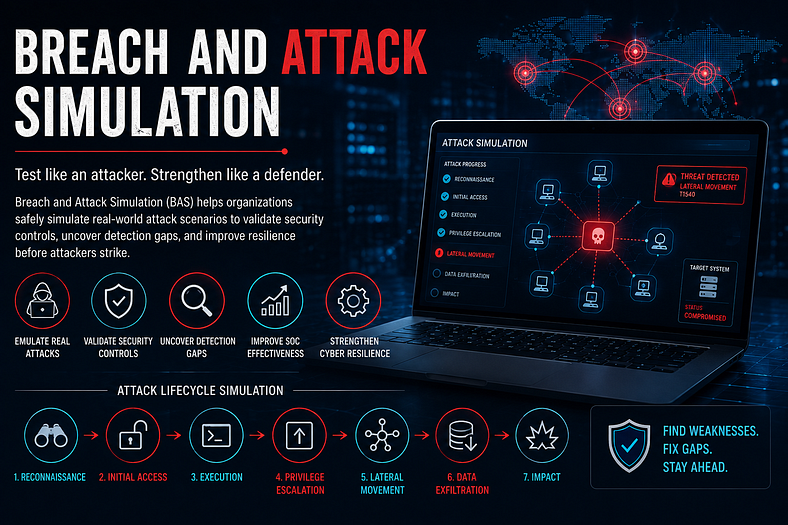
Breach and Attack Simulation is a structured, controlled approach to testing cybersecurity defenses using realistic attack techniques. Instead of waiting for a real breach to reveal security gaps, organizations can simulate adversarial behavior and evaluate how prevention, detection, monitoring, and response controls perform.
SISA describes BAS as a way to continuously test defenses against evolving attack techniques, identify hidden detection and configuration gaps, and improve security readiness.
What Is Breach and Attack Simulation?
Breach and Attack Simulation is a controlled cybersecurity testing methodology that recreates realistic attack techniques within an agreed scope.
The objective is not simply to find vulnerabilities. BAS evaluates whether existing security controls can:
- Prevent an attack
- Detect suspicious activity
- Generate appropriate alerts
- Provide sufficient security telemetry
- Support effective investigation
- Enable the security team to respond appropriately
SISA’s BAS service uses real-world tactics and controlled simulations to validate security effectiveness across an organization’s environment.
Unlike a conventional vulnerability scan, BAS focuses on how security controls perform when they encounter actual attack behaviors.
Why Breach and Attack Simulation Matters
Modern enterprises often operate with multiple security technologies from different vendors. Each tool may work correctly in isolation, but organizations need to understand whether the entire security ecosystem can identify and respond to an attack.
For example, an organization might have:
- EDR on endpoints
- A SIEM collecting logs
- Firewalls protecting the network
- WAF protecting web applications
- DLP protecting sensitive data
- Cloud security controls
- SOC analysts monitoring alerts
But what happens when an attacker uses a specific technique against the environment?
Will the firewall block it?
Will the EDR detect it?
Will the logs reach the SIEM?
Will an alert be generated?
Will the SOC recognize the activity?
BAS helps answer these questions through controlled attack simulations.
BAS vs Traditional Security Testing
Traditional security assessments remain important, but they typically answer different questions.
A vulnerability assessment may identify a vulnerable system.
A penetration test may demonstrate whether a vulnerability can be exploited.
Breach and Attack Simulation goes further by evaluating whether existing security controls can prevent or detect adversarial behavior.
In other words:
Vulnerability testing asks:
“What weaknesses exist?”
Penetration testing asks:
“Can these weaknesses be exploited?”
Breach and Attack Simulation asks:
“Can our defenses detect and respond when an attacker uses these techniques?”
These approaches can complement one another as part of a broader security validation strategy.
How Breach and Attack Simulation Works
A BAS engagement generally begins with planning and defining the scope of the simulation.
SISA describes an environment-ready execution process that includes identifying a host machine already feeding logs into the SIEM, confirming target-system availability, and setting up required administrative access and configurations.
The process can be viewed in several stages.
1. Define the Environment
Security teams identify the systems, networks, endpoints, cloud environments, applications, and other assets that will be included in the simulation.
2. Select Attack Scenarios
Attack scenarios are selected based on the organization’s environment and relevant threats.
3. Execute Controlled Simulations
Security specialists perform controlled attack activities designed to reproduce realistic adversarial behavior without unnecessarily disrupting production operations.
4. Monitor Security Controls
The organization observes whether security tools detect, block, or alert on the simulated activity.
5. Analyze Results
The results are reviewed to identify gaps in prevention, detection, logging, configuration, and response.
6. Improve and Retest
Security teams can remediate identified weaknesses and perform additional testing to determine whether the controls have improved.
Internal Threat Simulation
Not every attack begins from outside the organization.
An attacker may obtain an employee credential, compromise an endpoint, or gain access through another internal entry point.
Internal BAS testing evaluates how security controls respond to adversarial behavior inside the organization’s network.
SISA’s internal threat simulation includes activities such as process invocation and command execution, registry modifications, privilege escalation attempts, and user enumeration to assess areas such as credential exposure and internal detection capabilities.
This type of testing can help organizations identify weaknesses that may only become visible after an attacker has already gained internal access.
External Threat Simulation
External threat simulation evaluates the organization’s security posture from an attacker’s perspective outside the environment.
SISA describes external simulations that target public-facing infrastructure through controlled reconnaissance and simulated attacks, including custom web-based scripts targeting known CVEs. The testing is designed to evaluate exposure and detection capabilities without disrupting production environments.
External simulations can help organizations understand whether their internet-facing security controls are working as expected.
What Security Controls Can BAS Validate?
A major advantage of BAS is its ability to evaluate multiple layers of an organization’s security stack.
SISA’s BAS service validates telemetry, logging, alerting, and visibility across several areas.
Application Security
Testing can cover security controls associated with:
- IPS
- WAF
- Web servers
- Databases
- Microsoft 365
Endpoint Security
BAS can help validate:
- Antivirus
- EDR
- DLP
Cloud Platforms
Simulations can evaluate security visibility across environments such as:
- AWS
- Microsoft Azure
- Google Cloud
Network Security
Testing can include network controls such as:
- Firewalls
- Proxies
Operating Systems
Security teams can evaluate detection and visibility across operating systems such as Windows and Linux.
BAS and the MITRE ATT&CK Framework
Attackers use specific tactics and techniques throughout the attack lifecycle.
BAS exercises can align simulated activities with the MITRE ATT&CK framework, helping organizations understand which adversarial techniques are successfully prevented or detected.
This provides a common language for communicating security gaps between:
- Security leadership
- SOC teams
- Threat hunters
- Incident responders
- Security engineers
- IT teams
SISA states that its BAS services use threat simulations aligned with MITRE ATT&CK tactics.
What Does BAS Reveal?
A successful BAS engagement should provide more than a simple pass-or-fail result.
It can reveal:
Detection Gaps
A simulated attack may successfully execute without generating the expected alert.
Logging Gaps
Security events may occur but fail to reach the SIEM or another monitoring platform.
Configuration Issues
Security controls may be deployed but incorrectly configured.
Visibility Blind Spots
SOC teams may lack sufficient telemetry to understand what is happening.
Response Weaknesses
An organization may detect an attack but lack an effective response process.
Control Effectiveness
BAS helps determine whether security tools are performing as expected under realistic conditions.
Benefits of Breach and Attack Simulation
Evidence-Based Security Validation
BAS provides practical evidence about how security tools perform rather than relying solely on configuration reviews or vendor claims.
SISA highlights evidence-based validation of security technologies such as EDR, SIEM, and firewalls as one of the benefits of its BAS services.
Identify Detection Gaps
Organizations can identify missing alerts, incomplete telemetry, and weaknesses in detection logic before a real attacker exploits them.
Improve SOC Visibility
BAS can help security operations teams expand detection coverage and improve visibility across the environment.
Strengthen Incident Response
Simulated attacks can help organizations evaluate whether security teams recognize and respond to adversarial activity effectively.
Support Compliance Readiness
SISA identifies PCI DSS, ISO, and SEBI among the compliance areas for which BAS can contribute to readiness.
Improve Security Investment Decisions
Testing can help organizations understand which security controls are performing well and where additional investment or configuration improvements may be necessary.
Why Continuous Security Validation Matters
Cybersecurity environments are constantly changing.
New applications are deployed. Cloud configurations change. Employees join and leave. Security policies are modified. Software is updated. New vulnerabilities emerge.
As a result, a security control that worked during an assessment six months ago may not perform the same way today.
Continuous or recurring BAS helps organizations identify changes in security effectiveness and detection coverage.
Instead of asking:
“Did our controls work when we tested them?”
security teams can ask:
“Are our controls still working against current attack techniques?”
This shift from periodic assessment to continuous validation can improve security resilience.
BAS for Ransomware Readiness
BAS can also play an important role in ransomware preparedness.
Modern ransomware attacks may involve multiple stages, including initial access, privilege escalation, lateral movement, defense evasion, and impact.
Testing individual security controls may not reveal whether these stages can be detected as part of a connected attack.
SISA describes BAS as a way to simulate adversarial behavior and evaluate security effectiveness across the attack lifecycle.
This gives organizations an opportunity to identify weaknesses before a real ransomware attack reaches critical systems.
Real-World Example: Finding Detection Gaps
SISA reported a BAS engagement for a major financial services and digital payments organization in the Middle East.
The simulation identified critical security gaps involving insufficient log visibility, missing alerting rules, and misconfigurations. The organization then used the findings to develop a remediation roadmap and strengthen its detection posture.
This demonstrates why BAS is valuable: the objective is not to prove that an organization has security tools, but to determine whether those tools provide effective protection and detection in practice.
SISA’s Approach to Breach and Attack Simulation
SISA describes its BAS approach as combining threat intelligence, forensic insights, and tailored attack scenarios.
Its methodology emphasizes:
- Custom attack scenarios
- Intelligence-driven use cases
- Forensics-informed simulation design
- Expert execution
- Actionable results
Rather than relying only on generic simulations, SISA states that its scenarios are tailored to the organization’s environment and mapped to relevant MITRE tactics.
The company also positions its forensic experience as an important part of its approach, using insights from real breach investigations to inform simulation scenarios.
How Organizations Can Get More Value From BAS
To maximize the value of a BAS program, organizations should:
Define Clear Objectives
Determine whether the primary goal is to test EDR, SIEM visibility, ransomware readiness, cloud security, SOC detection, or another capability.
Include the Right Stakeholders
Security operations, infrastructure, network, cloud, application security, and incident response teams may all benefit from the results.
Prioritize Realistic Scenarios
Testing should reflect the threats most relevant to the organization’s industry and environment.
Track Detection Performance
Measure whether events are logged, alerts are generated, and security teams respond appropriately.
Remediate Findings
A BAS report is only useful if identified gaps are addressed.
Retest
After remediation, repeat relevant simulations to verify that the changes actually improved security effectiveness.
Conclusion
Breach and Attack Simulation is about testing cybersecurity defenses before attackers test them for you.
Security tools can provide strong protection, but organizations need evidence that those controls work against realistic attack techniques.
BAS provides that evidence by safely simulating adversarial behavior across internal, external, cloud, endpoint, application, and network environments. It can reveal gaps in prevention, logging, detection, configuration, SOC visibility, and response.
SISA’s approach combines controlled attack simulations with threat intelligence, forensic insights, MITRE ATT&CK-aligned scenarios, and actionable recommendations.
The ultimate goal is not simply to find another security weakness.
It is to answer a much more important question:
If an attacker targeted your organization today, would your defenses actually work?
Breach and Attack Simulation helps organizations find the answer — before a real breach does.


Comments
Post a Comment