PRISM AI Red Teaming: Proactively Testing AI Systems Against Real-World Attacks
Introduction
Artificial intelligence is becoming deeply integrated into modern businesses. Organizations are using large language models, AI assistants, autonomous agents, RAG applications, APIs, and machine learning systems to automate tasks and support important business decisions.
But as AI adoption grows, so does the attack surface.
Traditional cybersecurity testing can identify weaknesses in applications, networks, and infrastructure, but AI systems introduce vulnerabilities that require specialized testing. Attackers can manipulate prompts, extract sensitive information, bypass safety controls, exploit model behavior, and abuse connected tools.
This is where PRISM AI Red Teaming comes in.
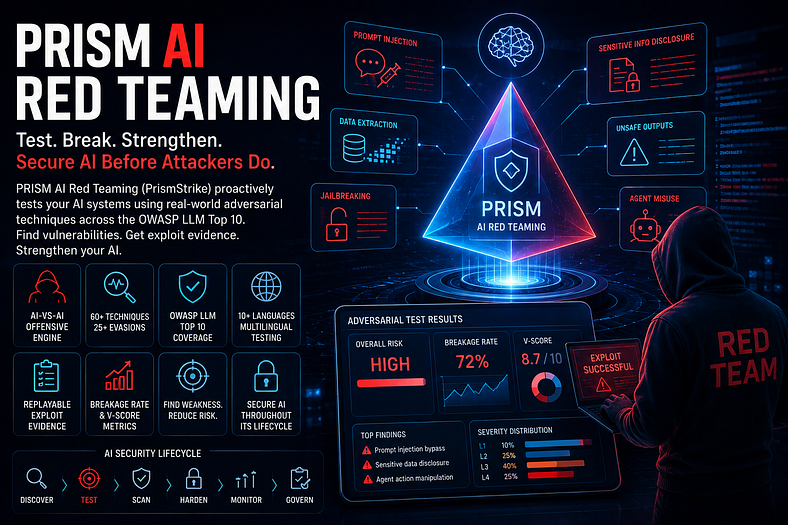
SISA PRISM includes PrismStrike, an AI red-teaming and adversarial testing module designed to test AI systems against the OWASP LLM Top 10 and a broader set of attack techniques. The platform describes its testing as producing replayable exploit evidence rather than simply providing scan results.
What Is AI Red Teaming?
AI red teaming is the process of deliberately attacking an AI system in a controlled environment to discover weaknesses before malicious attackers can exploit them.
Instead of asking whether an AI model works as intended, red teaming asks a more challenging question:
How can someone make this AI behave in a way it was never supposed to?
Security teams can use adversarial techniques to test areas such as:
- Prompt injection
- Data extraction
- Jailbreaking
- Sensitive information disclosure
- Model manipulation
- Unsafe outputs
- Access-control weaknesses
- Agent behavior
- AI application workflows
The goal is not to damage the AI system. The goal is to identify weaknesses, demonstrate how they can be exploited, and provide evidence that security teams can use for remediation.
Why Traditional Security Testing Is Not Enough
AI applications have many of the same vulnerabilities as traditional applications, but they also introduce another layer of risk.
A conventional web application may be tested for vulnerabilities such as SQL injection, cross-site scripting, broken authentication, and insecure access controls.
An AI application can have those weaknesses too.
However, it may additionally be vulnerable to attacks that target the model’s ability to interpret instructions and context.
For example, an attacker may attempt to:
- Override system instructions
- Extract hidden prompts
- Manipulate retrieved information
- Force an AI assistant to reveal confidential data
- Cause an AI agent to misuse a connected tool
- Bypass safety restrictions
This means organizations need AI-specific adversarial testing alongside conventional application security testing.
How PRISM AI Red Teaming Works
SISA’s PRISM platform describes its AI red-teaming capability as PrismStrike. It is designed to test AI systems using adversarial techniques across the OWASP LLM Top 10. The platform states that its engine supports more than 60 techniques and 25 evasions, with severity levels from L1 to L4.
The process can be understood through several stages.
1. Identify the AI System
The first step is understanding what needs to be tested.
This could include:
- LLM applications
- AI chatbots
- RAG systems
- AI APIs
- AI agents
- Enterprise assistants
- Machine learning applications
Understanding the AI application’s architecture helps testers identify its potential attack paths.
2. Build a Threat Profile
Different AI systems have different risks.
A customer-support chatbot may have access to customer information, while an internal AI assistant may have access to confidential company documents.
An autonomous agent may have permissions to interact with business applications.
PRISM’s AI security training materials describe threat profiling for each AI inference point and business-aware testing that maps workflows and defines misuse scenarios.
This approach helps testing focus on realistic business risks rather than only generic AI attacks.
Testing Against the OWASP LLM Top 10
The OWASP Top 10 for Large Language Model Applications provides a widely used framework for understanding common LLM security risks.
AI red teaming can test for issues associated with areas such as:
- Prompt injection
- Insecure output handling
- Training data poisoning
- Model denial of service
- Supply-chain vulnerabilities
- Sensitive information disclosure
- Insecure plugin or tool usage
- Excessive agency
- Overreliance on AI output
- Model theft
PRISM’s PrismStrike module specifically positions adversarial testing around the full OWASP LLM Top 10.
Prompt Injection Testing
Prompt injection is one of the most widely discussed AI security risks.
An attacker may provide carefully crafted instructions designed to manipulate an AI system into ignoring its original instructions.
For example, an attacker interacting with an enterprise chatbot may attempt to make it:
- Reveal confidential information
- Ignore security policies
- Expose hidden instructions
- Access unauthorized information
- Perform an unintended action
Red teaming can repeatedly test variations of these attacks to determine how resilient the AI system is.
Sensitive Data Extraction
AI systems can process large quantities of information, including potentially sensitive business data.
If security controls are poorly implemented, attackers may attempt to extract information through carefully designed prompts or indirect attacks.
Red team testing can evaluate whether an AI application unintentionally exposes:
- Personally identifiable information
- Customer information
- Internal documents
- Credentials
- System instructions
- Business-sensitive information
- Proprietary content
The objective is to identify whether the AI can be manipulated into crossing its intended information boundaries.
Testing AI Agents
AI agents introduce additional risks because they can perform actions rather than simply generate text.
An agent might be connected to:
- Databases
- APIs
- CRM systems
- Cloud platforms
- Internal applications
- External tools
This creates the possibility of excessive agency.
If an agent has more permissions than necessary, an attacker who successfully manipulates the agent may potentially influence actions beyond the intended scope.
AI red teaming should therefore test not only the model’s responses but also the actions the model can trigger.
Testing RAG Applications
Retrieval-Augmented Generation, or RAG, allows AI applications to retrieve information from external knowledge sources before generating responses.
RAG can improve accuracy, but it also introduces another attack surface.
Security testing can examine:
- Retrieval controls
- Document permissions
- Data isolation
- Malicious documents
- Prompt injection through retrieved content
- Sensitive information exposure
For example, an attacker may attempt to place malicious instructions inside a document that an AI system later retrieves.
Testing helps determine whether the AI can distinguish trusted information from malicious instructions.
AI-vs-AI Offensive Testing
One notable capability highlighted by PRISM is an AI-vs-AI offensive engine within PrismStrike. The platform positions this as part of its adversarial testing capabilities.
Instead of relying only on manually created test cases, AI-driven offensive testing can help generate and explore different attack patterns.
This can be valuable because attackers can continuously change their techniques.
An automated adversarial engine can help security teams test a wider range of attack variations and identify weaknesses that may not be found through a small collection of static test prompts.
Replayable Exploit Evidence
Finding a vulnerability is useful.
Being able to demonstrate it is even more valuable.
PRISM describes PrismStrike as producing replayable exploit trails, allowing security teams to understand and reproduce successful attacks rather than relying only on a vulnerability score.
This type of evidence can help teams answer:
- What attack was used?
- What input triggered the vulnerability?
- What did the AI return?
- What security control failed?
- Can the issue be reproduced?
- Did remediation actually fix the problem?
Reproducibility can make communication between security, development, AI engineering, and compliance teams much easier.
Measuring AI Security Risk
Security teams need measurable results to understand whether an AI system is improving.
PRISM describes metrics such as Breakage Rate and V-Score for its adversarial testing capability.
These types of metrics can help organizations track AI security performance over time.
For example, a business could compare results:
Before remediation → After remediation → During continuous testing
This makes AI security more measurable than simply maintaining a checklist of vulnerabilities.
Testing Across Languages
AI applications are increasingly used by global organizations.
An attack that fails in one language may behave differently in another.
PRISM states that PrismStrike supports testing in more than 10 languages, including high- and low-resource languages.
Multilingual adversarial testing can therefore be important for organizations operating across different countries and serving multilingual users.
AI Red Teaming for Regulated Industries
AI systems are increasingly being introduced into highly regulated sectors such as:
- Banking
- Financial services
- Healthcare
- Insurance
- Telecommunications
- Government
In these environments, AI failures can have serious consequences.
Organizations may need to demonstrate that appropriate security controls are in place and that AI systems have been assessed for potential risks.
SISA positions PRISM as a platform supporting compliance and governance across frameworks including ISO 42001, EU AI Act, NIST AI RMF, and HITRUST AI-44.
From Finding Vulnerabilities to Fixing Them
Red teaming should not end with a report.
The real objective is to reduce risk.
PRISM connects AI red teaming with other security capabilities in its broader platform.
Its lifecycle includes:
Discover → Test → Scan → Harden → Monitor → Govern
PrismSecure is designed to harden vulnerabilities inside AI models, while PrismObserve provides post-deployment monitoring and PrismGovern maps technical evidence to AI governance frameworks.
This creates a continuous approach rather than treating AI red teaming as a one-time assessment.
AI Red Teaming vs AI Vulnerability Scanning
AI vulnerability scanning and red teaming serve different purposes.
AI Vulnerability Scanning
Focuses on identifying known or detectable weaknesses.
AI Red Teaming
Attempts to actively exploit weaknesses using adversarial techniques.
A scan may tell you that a particular security weakness exists.
Red teaming can demonstrate how that weakness can actually be exploited.
Both approaches can therefore complement each other within an AI security program.
Benefits of PRISM AI Red Teaming
Identify AI-Specific Vulnerabilities
Organizations can test weaknesses that traditional application security tools may not detect.
Test Realistic Attack Scenarios
Adversarial testing can simulate how attackers might attempt to manipulate AI applications.
Produce Reproducible Evidence
Replayable exploit trails help security and development teams understand vulnerabilities.
Measure Security Improvements
Metrics such as Breakage Rate and V-Score can help organizations track security performance.
Support AI Governance
Testing evidence can contribute to broader AI security and compliance programs.
Protect AI Before Deployment
Testing can identify weaknesses before an AI system becomes deeply integrated into business workflows.
Building an AI Red Teaming Program
Organizations can establish a practical AI red-teaming program by following a structured process.
Step 1: Inventory AI Assets
Identify models, applications, agents, APIs, and other AI components.
Step 2: Understand Data and Permissions
Determine what information each AI system can access and what actions it can perform.
Step 3: Create Threat Profiles
Identify realistic misuse scenarios based on the business purpose of each AI system.
Step 4: Perform Adversarial Testing
Test prompt injection, data extraction, jailbreaks, excessive agency, and other relevant attack techniques.
Step 5: Document Evidence
Record successful attacks and their impact.
Step 6: Remediate
Apply appropriate security controls, guardrails, access restrictions, or model-level improvements.
Step 7: Retest
Run the same attack scenarios again to confirm that the vulnerabilities have been addressed.
Step 8: Monitor Continuously
Continue testing and monitoring as the AI system, model, data, and integrations change.
Why Continuous AI Red Teaming Matters
AI systems are not static.
Models change. Prompts change. RAG databases change. Agents gain new skills. APIs are added. Security controls are modified.
A model that passed a security test six months ago may not have the same risk profile today.
This is why continuous adversarial testing is becoming increasingly important.
PRISM describes its broader platform as providing continuous security across the AI lifecycle, from discovery and testing through hardening, monitoring, and governance.
Conclusion
AI is becoming an increasingly important part of business operations, but its unique attack surface requires a new approach to security testing.
PRISM AI Red Teaming, delivered through the PrismStrike capability, is designed to proactively challenge AI systems using adversarial techniques across the OWASP LLM Top 10 and broader attack techniques. It includes capabilities such as multilingual testing, AI-vs-AI offensive testing, severity classification, Breakage Rate and V-Score metrics, and replayable exploit trails.
The goal is simple:
Find out how your AI can be broken before someone else discovers it.
By combining AI discovery, adversarial testing, model scanning, hardening, runtime monitoring, and governance, organizations can move toward a more complete AI security lifecycle.
In an environment where AI is increasingly making decisions and taking actions, testing the AI like an attacker is no longer optional — it is becoming an essential part of securing modern enterprise systems.


Comments
Post a Comment