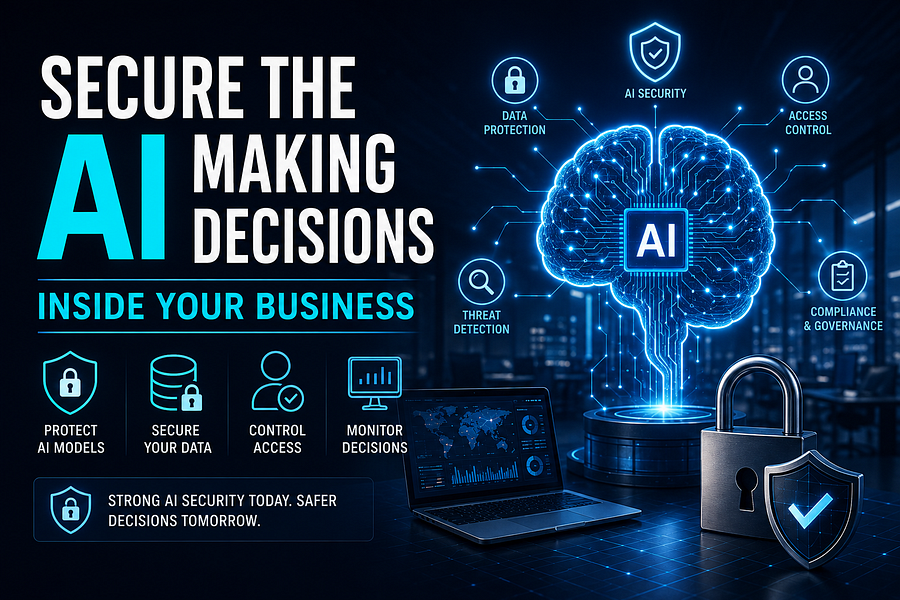
Secure the AI Making Decisions Inside Your Business
Introduction
Artificial intelligence is no longer limited to generating reports, answering customer questions, or helping employees find information. AI systems are increasingly making decisions that directly influence business operations.
They may approve or reject transactions, identify potential fraud, prioritize customers, recommend products, assess risks, screen applications, automate support decisions, and determine which actions should happen next.
This shift creates a new cybersecurity challenge: what happens when the AI making important decisions becomes the target of an attack?
Traditional cybersecurity focuses on protecting applications, networks, databases, endpoints, and users. But AI introduces another critical layer — the decision-making system itself.
An AI model can be manipulated through malicious inputs, compromised data, insecure integrations, unauthorized access, or poorly controlled automated actions. If an attacker influences the AI, they may not need to directly compromise the underlying business system. Instead, they can manipulate the decisions the system makes.
That is why organizations need to secure AI throughout its lifecycle, from training data and models to APIs, prompts, users, connected tools, and automated actions.
Why AI Security Is Becoming a Business Priority
Businesses are adopting AI because it can process information faster, automate repetitive tasks, identify patterns, and support decision-making at scale.
However, the more authority an AI system receives, the greater the potential impact of its compromise.
Consider an AI system used for:
- Fraud detection
- Credit or risk assessment
- Customer service
- Employee screening
- Financial analysis
- Insurance decisions
- Cybersecurity monitoring
- Supply chain management
- Healthcare operations
- Automated business workflows
If the system produces an incorrect recommendation, the consequences can range from financial losses to regulatory issues and reputational damage.
The challenge is therefore not simply to ask whether an AI model is accurate.
Organizations also need to ask:
Can the AI be manipulated?
Can unauthorized users influence its decisions?
Can sensitive information leak through the model?
Can the AI take actions it should not be allowed to take?
These questions form the foundation of AI security.
What Does It Mean to Secure an AI Decision-Making System?
Securing AI means protecting every component involved in producing and acting on an AI-generated decision.
This can include:
- Training data
- AI models
- Machine learning pipelines
- Prompts and instructions
- APIs
- Applications
- User identities
- Cloud infrastructure
- Vector databases
- Plugins and external tools
- Automated workflows
- Monitoring systems
A secure AI environment should ensure that the model receives trustworthy information, operates within defined boundaries, and cannot independently perform unauthorized actions.
Security should therefore be treated as a complete lifecycle rather than a single testing activity.
Understanding the AI Attack Surface
Traditional applications typically have clearly defined entry points. AI systems can have a much broader attack surface.
For example, a business AI assistant may receive information from users, databases, documents, APIs, websites, cloud services, and external tools.
Each connection creates another potential security risk.
An attacker may attempt to exploit:
The Model
Attackers can attempt to manipulate model behavior or identify weaknesses in how the model responds to specific inputs.
The Data
Compromised, poisoned, incomplete, or misleading data can influence AI outputs.
The Prompt
Malicious instructions can attempt to override system instructions or manipulate an AI application into performing unintended actions.
The API
Poorly secured APIs can allow unauthorized users to interact with AI models or access sensitive functionality.
Connected Tools
AI agents that can access databases, email, applications, or business systems create additional opportunities for abuse.
The User
Compromised employee accounts can be used to interact with AI systems with legitimate privileges.
Prompt Injection: A New Type of AI Security Risk
One of the major security concerns associated with AI applications is prompt injection.
Prompt injection occurs when an attacker provides instructions designed to influence an AI system into ignoring its intended behavior.
For example, imagine an AI assistant that summarizes internal company documents.
An attacker may attempt to insert malicious instructions into a document that tell the AI to reveal confidential information or perform an unintended task when the document is processed.
The problem becomes more serious when AI systems can access external tools.
A model that only generates text may produce an incorrect response.
An AI agent connected to business systems could potentially take an unauthorized action if appropriate controls are not in place.
Protect the Data Behind AI Decisions
AI systems depend heavily on data.
If the data used to train, fine-tune, retrieve, or operate an AI system is compromised, the resulting decisions can also become unreliable.
Organizations should establish strong controls around:
- Data collection
- Data storage
- Data access
- Data classification
- Data integrity
- Data retention
- Data transmission
Sensitive business information should not automatically become available to every AI application.
Organizations should determine what information the AI needs and restrict access to everything else.
This is where data discovery and classification can play an important role. Before sensitive information is connected to an AI system, organizations should understand what data they have, where it resides, and how sensitive it is.
Control What AI Can Access
An AI system should never receive unlimited access simply because it is capable of using that access.
This is particularly important for agentic AI systems that can perform tasks on behalf of employees.
For example, an AI assistant may have access to:
- Customer databases
- Financial systems
- Internal documents
- CRM platforms
- Cloud environments
- Business applications
Instead of providing unrestricted access, organizations should follow the principle of least privilege.
The AI should have only the permissions required to complete its specific task.
If an AI customer-support agent only needs to retrieve order information, it should not have permission to modify financial records.
Secure AI APIs and Integrations
Modern AI applications rarely operate in isolation.
They communicate with databases, APIs, cloud services, applications, and third-party platforms.
Every integration should therefore be treated as part of the AI attack surface.
Security teams should evaluate:
- Authentication
- Authorization
- API keys
- Access tokens
- Rate limiting
- Input validation
- Output validation
- Encryption
- Logging
- Third-party integrations
Poorly protected integrations can allow attackers to bypass the AI’s intended security boundaries.
Protect AI From Data Poisoning
Data poisoning is another potential threat to AI systems.
In a data poisoning scenario, an attacker attempts to introduce malicious or misleading information into datasets used to train or influence an AI system.
The objective may be to change how the model behaves or produces decisions.
Organizations can reduce this risk by implementing controls around:
- Data sources
- Dataset integrity
- Data validation
- Access permissions
- Training pipelines
- Dataset versioning
- Change monitoring
Organizations should know where AI data comes from and who is allowed to modify it.
Monitor AI Decisions
Security does not end when an AI system is deployed.
AI behavior should be continuously monitored for unusual activity.
Organizations can establish monitoring for:
- Unexpected model outputs
- Unusual user behavior
- Large volumes of requests
- Repeated attempts to bypass controls
- Abnormal API activity
- Sensitive data exposure
- Unexpected tool usage
- Changes in model behavior
Monitoring provides an opportunity to identify attacks before they become major incidents.
It can also help organizations determine whether an AI system is operating within its intended boundaries.
Human Oversight Still Matters
Automation does not mean removing humans from every decision.
For high-impact decisions, organizations should consider maintaining human oversight.
For example, an AI system may recommend that a transaction is fraudulent, but a trained employee could review the decision before permanently blocking an important customer account.
Human oversight becomes particularly important when decisions involve:
- Financial transactions
- Legal consequences
- Employment
- Healthcare
- Customer eligibility
- Security incidents
- Access to critical systems
The objective is not necessarily to eliminate AI automation. Instead, organizations should determine where human approval is necessary.
Test AI Systems Before Attackers Do
AI security testing can help organizations identify weaknesses before systems are deployed at scale.
Testing can evaluate areas such as:
- Prompt injection
- Model manipulation
- Sensitive information disclosure
- Access control
- Authentication
- API security
- Data security
- AI application logic
- Connected tools
- Agent permissions
Traditional application security testing alone may not identify every AI-specific weakness.
AI security assessments should therefore consider both conventional application vulnerabilities and AI-specific attack scenarios.
Build AI Security Into the Development Lifecycle
AI security should not be added after a model has already been deployed.
Security should be considered during:
Planning → Data Collection → Development → Training → Testing → Deployment → Monitoring → Retirement
This approach is often referred to as Secure AI by Design.
During development, organizations should define:
- What the AI is allowed to do
- What information it can access
- Who can use it
- What actions require approval
- How outputs will be validated
- How incidents will be detected
- How the system can be disabled
Clear security boundaries make AI systems easier to monitor and control.
AI Governance and Accountability
Security is only one part of responsible AI adoption.
Organizations also need governance.
An effective AI governance framework should define:
- AI ownership
- Acceptable use
- Data access policies
- Security requirements
- Model testing requirements
- Risk assessment
- Human oversight
- Incident response
- Regulatory responsibilities
- Vendor management
Organizations should also maintain an inventory of AI systems operating within the business.
Shadow AI — where employees use AI tools without formal approval — can create significant visibility and data protection challenges.
What Businesses Should Do Now
Organizations adopting AI can take several practical steps to improve security.
1. Create an AI Inventory
Identify every AI model, application, agent, and third-party AI service being used.
2. Map Data Access
Determine what information each AI system can access.
3. Apply Least Privilege
Give AI systems only the permissions required for their specific tasks.
4. Secure APIs
Protect integrations with strong authentication, authorization, encryption, and monitoring.
5. Test AI Applications
Perform security testing designed to identify AI-specific vulnerabilities.
6. Monitor Behavior
Continuously monitor AI interactions, outputs, and automated actions.
7. Maintain Human Oversight
Require human approval for high-risk decisions and sensitive actions.
8. Prepare an AI Incident Response Plan
Define what happens if an AI model is compromised, manipulated, or begins producing unsafe decisions.
The Future of AI Security
AI adoption is moving from simple chatbots toward increasingly autonomous systems capable of planning tasks, accessing business information, and executing actions.
This evolution makes AI security even more important.
The future of cybersecurity will not only involve protecting the systems that humans use. It will also involve protecting systems that make decisions and act on behalf of humans.
Organizations that adopt AI without appropriate security controls may unintentionally create new attack paths into their businesses.
Those that integrate security, governance, testing, monitoring, and human oversight from the beginning will be better positioned to use AI safely.
Conclusion
AI is becoming part of the decision-making engine behind modern businesses. From detecting fraud to assisting customers and automating workflows, AI can influence decisions that have real financial, operational, and reputational consequences.
That makes the AI itself a security asset that needs protection.
Secure the AI making decisions inside your business — not just the infrastructure surrounding it.
Organizations should protect AI models, data, APIs, identities, integrations, and automated actions while continuously testing and monitoring how these systems behave.
The goal is not to slow down AI adoption. It is to make AI adoption secure, controlled, accountable, and resilient so businesses can benefit from intelligent automation without creating an entirely new security blind spot.


Comments
Post a Comment